THE RESEARCH SAYS
EP.
14
Digital CAD/CAM vs. Traditional Crowns
Marginal fit, internal adaptation, and survival of digital vs. conventional crowns are statistically equivalent, per Tsirogiannis's 2016 meta-analysis.
THE RESEARCH SAYS
EP.
14
The verdict
StrongHold the material constant (same lithium disilicate, same cement), and digital and conventional crown workflows produce statistically equivalent marginal fit, internal adaptation, and survival. Digital's real advantage is speed and consistency, not a tighter margin. Where digital exposes you is prep quality: the lab technician who used to quietly smooth a rough margin isn't in the loop anymore, and that's on you, not the mill.
Strong evidence: three meta-analyses and a matched cohort agree
Every dental forum has some version of this argument: the "real dentistry" crowd insisting nothing beats a PVS impression and a good technician, and the digital crowd insisting anyone still pouring stone models in 2026 is leaving money and accuracy on the table. Both sides talk like it's settled. It is settled, just not the way either side thinks.
Here's the actual comparison worth making, because "digital vs. conventional" as usually argued mixes up two different variables. Compare like with like: intraoral scan, digital design, milled lithium disilicate crown, versus PVS impression, stone model, wax-up, pressed lithium disilicate crown. Same ceramic, same cement, only the fabrication path differs. That's the question the research actually answers.
The question
For a single-unit crown, does a digital workflow (scan, design, mill) produce a clinically different result than a conventional workflow (impression, stone model, press) on four things that matter: marginal integrity, internal fit, fracture resistance, and long-term survival? A meaningful difference means crossing an established clinical threshold (the long-standing ~120 µm ceiling for an acceptable marginal gap) or a real gap in survival or complication rates, not a few-micron statistical footnote.
The mechanism
Every step in the conventional chain is a place error can compound: impression material can shrink or tear on removal, gypsum stone expands slightly as it sets, die spacer goes on by hand in a variable number of coats, and a wax pattern can distort before it's invested and cast. Digital fabrication collapses most of that into one measurement and one machining pass (the cement space is a defined software parameter, not a hand-painted coat), which is why digital dies tend to show the least discrepancy in head-to-head studies. What digital doesn't do is compensate for a bad impression of the prep itself: a scanner records exactly what's there, undercuts and feather edges included, with no technician downstream to quietly clean it up.
What the evidence says
Chochlidakis et al., 2016: systematic review and meta-analysis
What they did: Searched Medline, Cochrane, and EMBASE for studies comparing marginal and internal fit of fixed restorations fabricated from digital versus conventional impressions 1.
What they found: Digital restorations showed misfit similar to conventional overall (P>.05). Stone die casts produced the greatest discrepancies of any die type; digital dies produced the smallest (P<.05). Fabrication technique and restoration type had no independent effect on misfit 1.
Why it matters: The weak link in the conventional chain isn't the impression itself. It's the stone model step, which digital skips entirely.
Tsirogiannis et al., 2016: systematic review and meta-analysis
What they did: Pooled 12 studies measuring marginal fit of single-unit ceramic restorations after digital or conventional impressions, analyzing in vivo and in vitro data separately 2.
What they found: In vivo, digital impressions averaged a 56.1 µm marginal gap (95% CI 46.3–65.8) versus 79.2 µm for conventional (95% CI 59.6–98.9). In vitro the gap nearly closed: conventional at 58.9 µm, digital at 63.3 µm. No statistically significant overall difference, and both methods sit comfortably under the classic 120 µm threshold 2.
Why it matters: This is the number worth actually quoting. Both approaches land inside what's considered clinically acceptable; digital's edge shows up mainly in vivo, where conventional impressions have more room to go wrong.
Pachiou et al., 2024: systematic review and meta-analysis (e.max Press vs. e.max CAD)
What they did: Pooled 17 studies comparing marginal adaptation of lithium disilicate crowns made by the conventional heat-pressed method (IPS e.max Press) against the CAD/CAM milled method (IPS e.max CAD): the exact same ceramic in both arms 3.
What they found: No statistical difference between fabrication methods (P=.49). The heat-pressed technique was numerically a touch tighter, but both were clinically acceptable 3.
Why it matters: This is the cleanest test of the actual question (hold the ceramic constant, vary only how it's made), and the answer is a wash.
Mahato et al., 2024: Cureus systematic review
What they did: Reviewed 22 studies published 2012–2023 comparing digital and conventional workflows for fixed prosthesis fabrication on precision, efficiency, cost, and clinical performance 4.
What they found: Digital workflows reduced working time and material consumption and were associated with greater patient satisfaction and comparable-or-higher success rates than conventional workflows 4.
Why it matters: Broadens the picture past marginal fit alone, on efficiency and patient experience, digital comes out ahead, not just even.
Mathar, 2024: systematic review
What they did: Pooled 3 studies, 60 patients total, comparing marginal fit and internal adaptation of CAD/CAM versus conventionally fabricated ceramic crowns 5.
What they found: CAD/CAM crowns trended toward smaller marginal gaps and better internal adaptation, but the difference didn't reach statistical significance 5.
Why it matters: Same direction as the larger reviews, but the evidence base here is thin: three studies won't settle anything alone.
Rollor et al., 2025: retrospective cohort study
What they did: Split-mouth design: 31 patients received both a digitally fabricated and a conventionally cast posterior ceramic crown, observed 1–8 years 6.
What they found: No significant difference in tooth-survival probability (P=.14) or complication rates (P>.05) between digital and conventional crowns. Digital crowns were seated significantly faster: 21 days from final impression to insertion versus 41 for conventional (P=.0006) 6.
Why it matters: The closest thing here to real long-term clinical outcomes, and it agrees with the lab-bench studies: equivalent prognosis, faster turnaround for digital.
McLean & von Fraunhofer, 1971: the threshold itself
What they did: Measured cement film thickness under crowns seated in vivo, establishing what became the field's standard benchmark for an acceptable marginal gap 7.
What they found: Roughly 120 µm as the ceiling for a clinically tolerable gap: a number still cited more than fifty years later by every study above.
Why it matters: Every modern comparison is graded against this exact line, and per Tsirogiannis's pooled numbers, both digital and conventional finish well inside it.
Evidence at a glance
| Study | Design | Sample | Follow-up | Finding | Weight |
|---|---|---|---|---|---|
| Chochlidakis et al., 2016 1 | Systematic review & meta-analysis | Multiple studies, mostly in vitro | n/a | Digital fit comparable/better; stone models the weak link | High |
| Tsirogiannis et al., 2016 2 | Systematic review & meta-analysis | 12 studies pooled | n/a | No significant difference; both under 120 µm | High |
| Pachiou et al., 2024 3 | Systematic review & meta-analysis | 17 studies (e.max vs. e.max) | n/a | No significant difference (P=.49), material held constant | High |
| Mahato et al., 2024 4 | Systematic review | 22 studies | 2012–2023 | Digital favorable on efficiency and patient satisfaction | Moderate |
| Rollor et al., 2025 6 | Retrospective cohort | 31 patients / 62 teeth | 1–8 yr | No significant difference in survival/complications; digital faster | Moderate |
| Mathar, 2024 5 | Systematic review | 3 studies, 60 patients | n/a | Trend favoring digital, not significant | Low |
| McLean & von Fraunhofer, 1971 7 | In vivo clinical study | >1,000 crowns | n/a | Established the ~120 µm acceptable-gap threshold | Moderate |
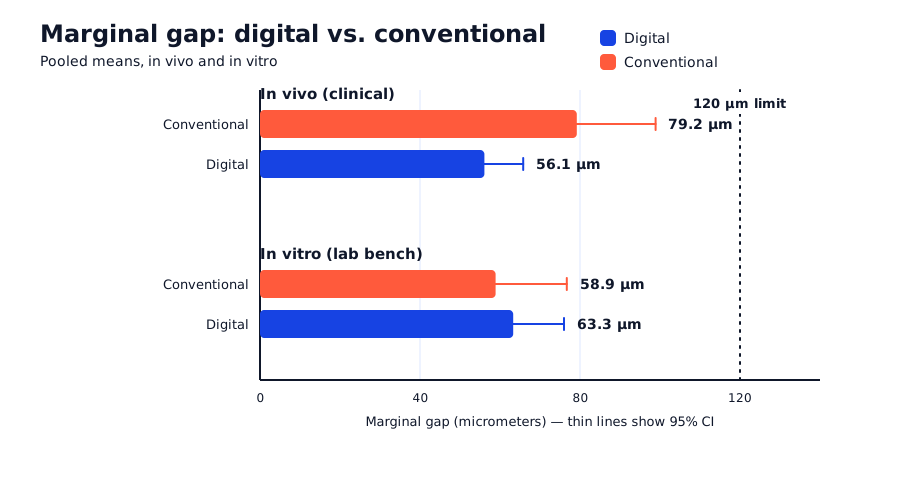
Pooled marginal-gap means with 95% confidence intervals, digital vs. conventional. Both methods finish well inside the classic clinically-acceptable threshold. Data from 2 and 7.
Where the evidence is thin
- Most marginal-fit data is in vitro and lithium-disilicate-specific. It hasn't been verified across every ceramic system, multi-unit bridges, or genuinely difficult preps (deep subgingival margins, minimal ferrule).
- Long-term, material-held-constant survival data is limited to one retrospective cohort (Rollor et al., 31 patients, not randomized): solid, but a single study.
- Fracture resistance comparing milled versus pressed lithium disilicate, specifically, wasn't found as a verified head-to-head in the time available for this article. It's a real question; it just isn't answered here with a citation.
- Almost none of this literature measures operator learning curve: how prep quality interacts with each workflow in the hands of someone still building scanning skill.
Ryan's take on the part nobody's measuring
Here's something no meta-analysis will ever capture, so take it as clinical opinion, not evidence: a skilled lab technician has always been a quiet safety net. Hand them a slightly rough margin or a case with marginal reduction, and a good tech smooths it, compensates, makes it work. The mill doesn't do that. It machines exactly what the scan captured, error included. Digital doesn't punish bad dentistry more than conventional does. It just removes the last person in the chain who used to catch it before the patient did.
What this means Monday morning
- If your lab is strong and the case suits pressing, conventional remains a fully defensible choice. The fit data backs it. This isn't a "digital or you're behind" situation.
- If you're scanning, treat the scan as your only shot at the margin. There's no technician downstream to clean up an ambiguous finish line.
- Verify reduction before you scan, not after, with a putty matrix or reduction guide. Digital rewards a precise prep more than it forgives an imprecise one.
- Know your mill's cement-space parameter and set it deliberately for the case, the same way you'd trust a technician's die-spacer coats.
- Choose on logistics, turnaround, and economics, not fear the crown will fail. The evidence says fit and survival are a wash, which means what you're actually paying your lab is a fair place to focus the decision instead.
The bottom line
Digital and conventional crown fabrication are, material held constant, statistically and clinically equivalent on marginal fit, internal adaptation, and survival: three meta-analyses and a matched cohort all land in the same place. Digital's genuine advantage is speed and consistency, not a tighter margin nobody can actually feel. The real variable left standing is the one no study measures: your prep, once the safety net of a human technician is gone, which is worth the same honest look you'd give how long a crown actually lasts or when it needs to be a crown at all.
References
- Chochlidakis KM, Papaspyridakos P, Geminiani A, Chen CJ, Feng IJ, Ercoli C. Digital versus conventional impressions for fixed prosthodontics: a systematic review and meta-analysis. J Prosthet Dent. 2016;116(2):184-190. DOIPubMed
- Tsirogiannis P, Reissmann DR, Heydecke G. Evaluation of the marginal fit of single-unit, complete-coverage ceramic restorations fabricated after digital and conventional impressions: a systematic review and meta-analysis. J Prosthet Dent. 2016;116(3):328-335. DOIPubMed
- Pachiou A, Zervou E, Tsirogiannis P, Sykaras N. Evaluation of the marginal fit of lithium disilicate single crowns fabricated with the conventional (IPS e.max Press) and CAD/CAM (IPS e.max CAD) methods: a systematic review and meta-analysis. Int J Comput Dent. 2024;27(4):365-377. DOIPubMed
- Mahato M, Hota S, Jain A, Dutta D, Bhushan P, Raut A. Comparison of conventional and digital workflows in the fabrication of fixed prostheses: a systematic review. Cureus. 2024;16(6):e61764. DOIPubMed
- Mathar MI. Comparative analysis of the marginal fit and internal adaptation of CAD-CAM-fabricated versus conventionally fabricated ceramic crowns: a systematic review. J Pharm Bioallied Sci. 2024;16(Suppl 4):S3086-S3088. DOIPubMed
- Rollor S, Kwak KH, Oh SL. Digitally fabricated posterior ceramic crowns versus conventionally fabricated cast crowns: a split-mouth retrospective cohort study. BMC Oral Health. 2025;25(1):1515. DOIPubMed
- McLean JW, von Fraunhofer JA. The estimation of cement film thickness by an in vivo technique. Br Dent J. 1971;131(3):107-111. DOIPubMed
This article summarises published research for clinicians. It is not a substitute for your own reading of the studies or your clinical judgment.
Questions
What dentists ask about this.
Are digital CAD/CAM crowns as accurate as traditional lab-made crowns?
Yes: hold the material constant and digital and conventional workflows produce statistically equivalent marginal fit, internal adaptation, and survival. In vivo, digital crowns averaged a 56.1 µm marginal gap versus 79.2 µm for conventional, and both fall well inside the classic 120 µm acceptable-gap threshold.
What is the biggest risk of switching to a digital crown workflow?
Prep quality. A scanner records exactly what's there, undercuts and feather edges included, with no lab technician downstream to quietly clean up a rough or ambiguous margin the way a good tech used to.
Is a milled crown faster to deliver than a conventionally pressed crown?
Yes. A retrospective cohort found digital crowns were seated significantly faster (21 days from final impression to insertion versus 41 days for conventional) with no significant difference in tooth-survival probability or complication rates.
Does digital crown fabrication improve fracture resistance or survival over conventional crowns?
Not measurably. Three meta-analyses and a matched cohort study all found equivalent survival and complication rates between digital and conventional workflows when the ceramic material is held constant; digital's real advantage is speed and consistency, not strength.
What is the accepted threshold for a clinically acceptable crown marginal gap?
Roughly 120 micrometers, a benchmark established in 1971 and still cited by every modern comparison. Pooled data shows both digital and conventional crowns land well inside that limit.
From the reference library
Where to next
Clinical judgement is half of it. The other half is the business around the chair.