
“How long will this crown last, Doc?”
It is the question every patient asks the moment treatment is presented. And if we are honest, it is the question many of us answer with a vague pleasantry like, “It depends,” or “A very long time if you take care of it.”
But “it depends” is not a clinical diagnosis, and it certainly isn’t an answer that builds trust. Having a clear, evidence-based understanding of the data not only helps you set realistic patient expectations but also helps you make better decisions regarding material selection and risk assessment.
In this edition of The Research Says, we are cutting through the anecdotes and marketing hype. We are looking at the highest-quality systematic reviews to answer the question: How long do crowns really last?
The Survival Rates: 5, 10, 15, and 20 Years
Longevity is a complex interplay of material science, biomechanics, and biology. However, when you look at large-scale systematic reviews that pool data from dozens of long-term studies, a consistent statistical picture emerges.
For a well-executed crown on a generally healthy patient, here is what the data predicts:
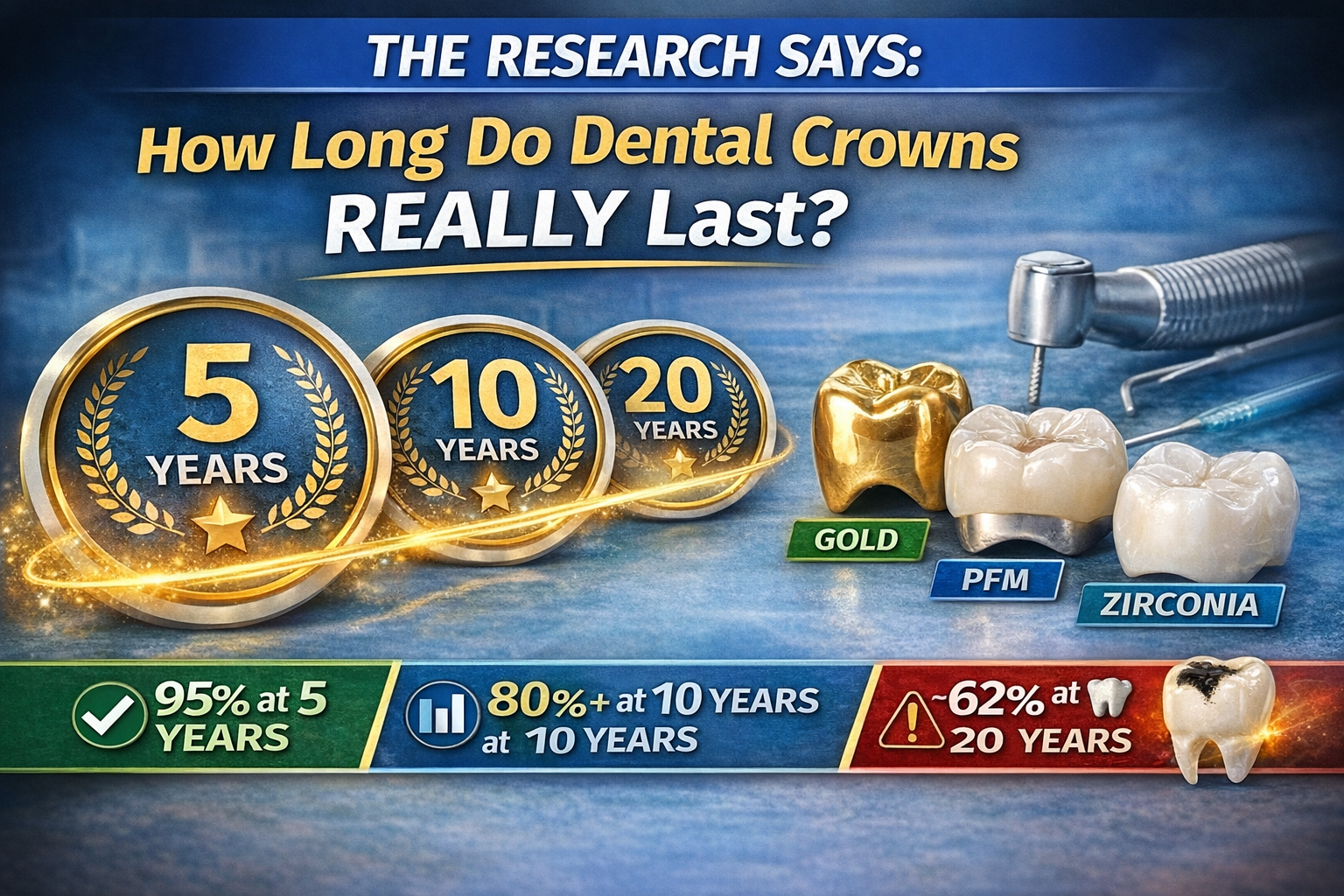
- 5-Year Survival: ~95%
- 10-Year Survival: ~80–85%
- 15-Year Survival: ~70%
- 20-Year Survival: ~62%
The Takeaway: When a patient asks, you can confidently state that the majority of crowns last well over a decade, and a significant portion (over 60%) will still be functioning perfectly after 20 years. It is not a lifetime guarantee, but the odds are heavily in their favor.
The Material Debate: Gold vs. Zirconia vs. PFM
Which material actually holds up best? If you looked at the literature ten years ago, the answer was clear: Gold was the undisputed king, followed by PFM, with early ceramics trailing significantly behind (some early ceramic studies showed only 48% survival at 10 years).
But the landscape has changed.
Modern material science—specifically the evolution of Zirconia—has closed the gap. Recent studies looking at 11 years of follow-up data found no significant difference in survival rates between modern Zirconia, PFM, and Gold.
The Current Ranking: Based on the total body of evidence, full Gold crowns likely still hold a slight edge for pure longevity in the very long term. However, modern Zirconia and PFM are statistically comparable in the 10-year range. We no longer have to sacrifice esthetics for durability the way we once did.
The Top 4 Reasons Crowns Fail
If the materials are so strong, why do restorations eventually fail? The research is incredibly specific on this, and the results might change how you talk to your patients about hygiene.
- Recurrent Caries (38%): The absolute number one reason for failure. A new cavity forming at the margin causes over a third of all failures.
- Loss of Retention (26%): The crown simply debonds or comes off.
- Structural Fracture (12%): Breakage of the porcelain/material or fracture of the underlying tooth.
- Endodontic/Biologic Complications (5–7%): The tooth becomes necrotic or requires RCT after placement.
The “Patient Factor” Variables
We know the averages, but how do specific patient factors skew the numbers?
- Age: Surprisingly, a 2022 study suggests patient age does not significantly influence survival rates. An older patient’s crown has the same statistical prognosis as a younger patient’s.
- Caries Risk: This is the biggest variable. Since 38% of failures are due to recurrent decay, high-risk patients have dramatically lower survival rates.
- Bruxism: Unmanaged bruxism significantly increases the risk of failure (usually via fracture). However, this risk drops dramatically if the patient wears a night guard.
- Vitality: Crowns on non-vital (endodontically treated) teeth consistently have higher failure rates than those on vital teeth due to structural compromise.
Conclusion: The Evidence-Based Patient Conversation
So, what is the actionable takeaway? When a patient asks how long their crown will last, don’t guess. Use the data to make them a partner in their own success.
Try saying this: “The research shows us that about 95% of these are perfect at five years, and the majority last over 20 years. However, the number one reason they fail isn’t the crown breaking—it’s a new cavity starting at the edge. That means the single biggest factor in how long this lasts is actually how well we keep that edge clean.”
This builds trust, sets realistic expectations, and empowers the patient.
References & Further Reading
- Pjetursson BE, et al. (2004). A systematic review of the survival and complication rates of fixed partial dentures (FPDs) after an observation period of at least 5 years. Clinical Oral Implants Research.
- Sailer I, et al. (2007). A systematic review of the survival and complication rates of all-ceramic and metal-ceramic reconstructions… Clinical Oral Implants Research.
- Scherrer SS, et al. (2022). A multifactorial retrospective clinical study on 1,524 tooth-supported single crowns. Part 1: Distribution of failures and survival. Journal of Dentistry.
- Walton TR. (2007). A 10-year longitudinal study of the clinical performance of tooth-supported single crowns. The International Journal of Prosthodontics.