
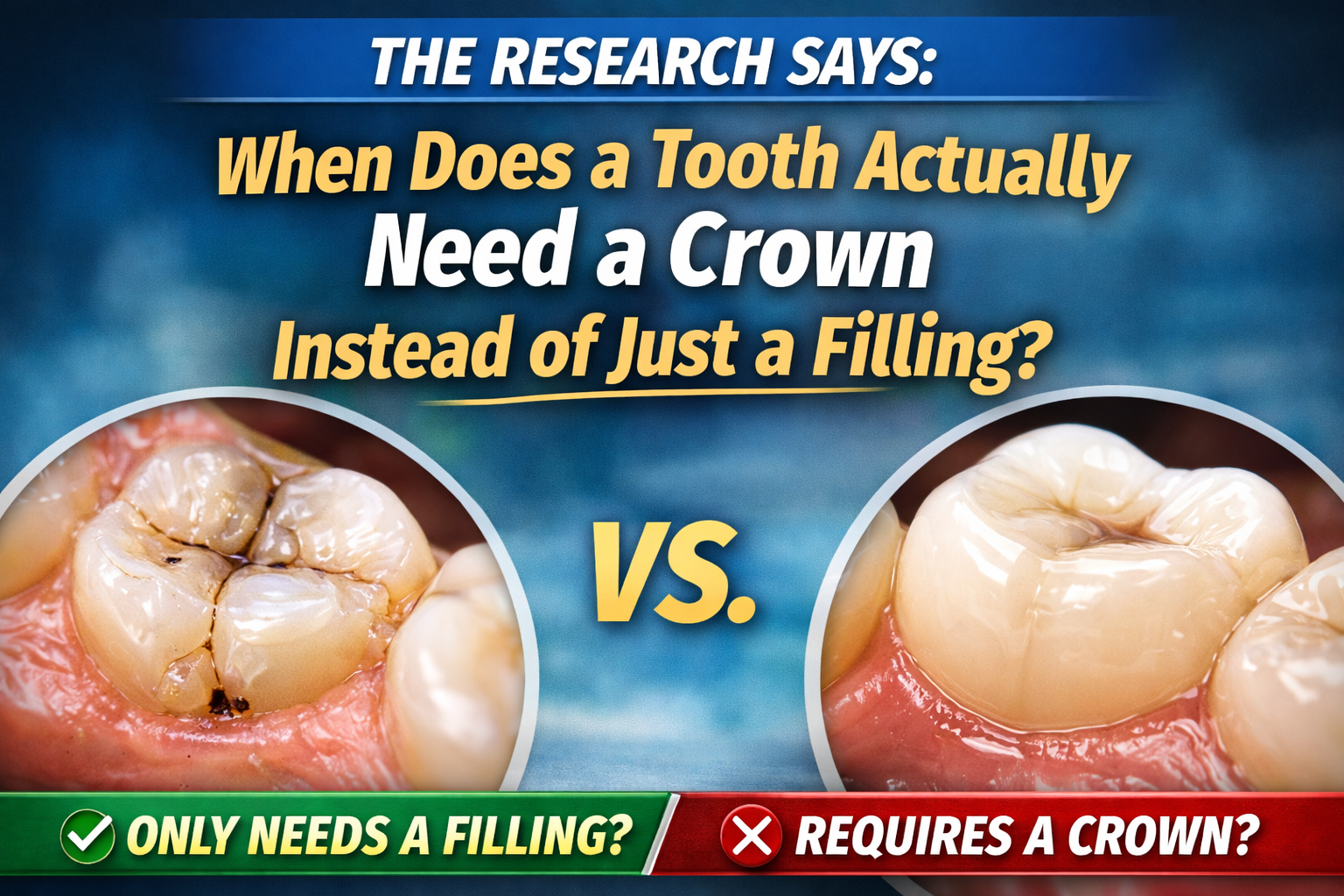
We all know the conversation. The patient asks, “Can’t you just put a bigger filling in there?”
And if we’re being honest, our internal red line for when to make that call can feel a bit fuzzy. It often comes down to a “gut feeling.” But a gut feeling doesn’t create consistency, and it certainly doesn’t give you the rock-solid conviction you need to confidently explain a treatment plan.
In this edition of The Research Says, we are replacing that gut feeling with hard data. We are looking at the clear, objective indicators that a tooth has crossed the line from needing a simple patch to needing full structural reinforcement.
The Core Principle: Patch vs. Brace
Before we look at the studies, we need to define the physics. A filling is designed to fill a hole—it’s a patch. A crown is designed to be a structural brace.
Teeth become structurally weak when cracks, wide preparations, or the loss of a marginal ridge turn cusps into thin, unsupported walls. Our job is to identify the precise point where the structural weakness becomes too great for a simple filling to handle.
The 4 Research-Backed Red Lines
So, when is a crown the superior solution? The evidence points to four specific scenarios.
1. The Cracked Tooth
What do you do with that little crack line running from an old amalgam across a marginal ridge?
- The Research: A 2022 study in the Journal of Endodontics followed cracked teeth for 11 years. They found that placing a crown early improved the long-term prognosis by 98%.
- The Endo Connection: An earlier study found that if cracked teeth with reversible pulpitis were crowned immediately, they had an 80% chance of avoiding a root canal altogether.
- The Verdict: When you see a definitive crack, early cuspal coverage is mandatory to prevent endo.
2. The “One-Third” Rule (Isthmus Width)
How wide is too wide?
- The Research: A European study identified that an isthmus width (the narrowest part of the prep) that is greater than 1/3 of the total intercuspal distance is one of the greatest predictors of fracture.
- The Verdict: Once your prep crosses that 1/3 line, a large filling acts like a wedge. Cuspal coverage is the recommended treatment.
Watch the full, in-depth guide.
3. The Endodontically Treated Tooth
Should this even be a debate anymore?
- The Research: A study in the Journal of Prosthetic Dentistry found that posterior teeth without a crown after RCT were 6 times more likely to be extracted compared to those that were crowned.
- The Verdict: Failing to crown a posterior endo-treated tooth leaves it vulnerable to catastrophic failure.
4. The Fractured Cusp
This is the simplest one. Clinical consensus is in total agreement: If a structural component (cusp) is lost, a filling cannot replace the function. A crown is the standard of care.
The “Standard of Care” Consensus
Beyond the academic papers, what do your peers actually do? The National Dental Practice-Based Research Network surveyed over 2,000 dentists to find the “real world” standard.
- Failing DO Filling: About 50% of dentists would recommend a crown.
- Failing MOD Filling: About 66% (2/3) of dentists would recommend a crown.
- Fractured Cusp: 97% of dentists would recommend a crown.
This benchmark is incredibly helpful. If you have a large failing MOD and you recommend a crown, you are well within the standard of care and in good company with the majority of your peers.
The Risk Modifiers
If you are on the fence—maybe the crack is subtle or the prep is right on that 1/3 line—look at the patient-specific risk factors.
- High Caries Risk: A 2014 JDR study showed this significantly increases failure rates of large composites.
- Bruxism: Heavy occlusal forces dramatically lower the survival rate of large fillings.
These factors are like pouring gasoline on a fire. If they are present, push the scale toward a crown.
Conclusion: The Clinical Checklist
Here is your Monday Morning Checklist. Does the tooth have:
- A definitive crack?
- A prep wider than 1/3 the intercuspal distance?
- A root canal?
- A fractured cusp?
If the answer is YES to any of these, the evidence supports a crown. If you are on the fence, check for bruxism or high caries risk to break the tie.