THE RESEARCH SAYS
EP.
13
Is Amalgam Bad or Not?
Two randomized trials (NECAT, Casa Pia) found no measurable harm from amalgam. The FDA still flags some patients. That's precaution, not new evidence.
THE RESEARCH SAYS
EP.
13
The verdict
StrongTwo large randomized trials (five and seven years of follow-up, real children, not rats) found no statistically significant difference in IQ, memory, kidney function, or nerve conduction between kids restored with amalgam and kids restored with composite. The FDA still steers a handful of higher-risk groups toward alternatives when practical, and a global treaty is phasing amalgam down. Neither fact is evidence the fillings already in your patients' mouths are hurting them. They're two different conversations, and the internet keeps having only one of them.
Strong evidence: two RCTs and a Cochrane review
A patient points at a molar and asks, "Is it true my old silver filling has mercury in it, and is it poisoning me?" Half the internet says amalgam is a slow neurotoxin dentistry won't admit to. The other half (us) tends to wave it off with "it's fine, always has been," which is true but sounds like exactly what someone hiding something would say.
Here's what makes this one different: amalgam may be the single most rigorously studied restorative material we have, including actual randomized controlled trials in children over years of follow-up. We don't have RCT-level evidence on how long most of our composites last, or even on when a tooth needs a crown instead of a filling in the first place. We have it for whether amalgam damages a developing nervous system.
So this isn't "trust me, I'm a dentist." Regulators haven't gone quiet: the FDA updated its guidance in 2020, and a global treaty is actively phasing amalgam down. Both are real. Neither is proof amalgam harms the people who already have it in their teeth. Holding both facts at once is the whole article.
The question
Precisely: in patients needing a posterior restoration (the trials enrolled children, the group everyone worries about most) does placing amalgam produce measurably worse systemic outcomes (neuropsychological performance, kidney function, nerve conduction, behavior) than placing resin composite, over years of follow-up? A meaningful difference would look like a consistent, clinically relevant gap across independent trials, not an isolated finding buried among dozens of comparisons: exactly the kind of noise you'd expect from chance alone.
The mechanism
Mercury's reputation problem is a units-and-forms problem. The mercury in fish that's rightly a concern is methylmercury, an organic form that bioaccumulates and is neurotoxic at low doses. Dental amalgam is elemental mercury bound in a solid alloy with silver, tin, and copper: a different chemical animal. It isn't inert: amalgam releases small amounts of mercury vapor, more with chewing or during placement and removal. The question was never whether amalgam releases zero mercury. It's whether that exposure, at the levels a filling actually produces, translates into measurable harm. That's testable, and for once, someone tested it.
What the evidence says
Worthington et al., 2021: Cochrane systematic review
What they did: Cochrane Oral Health updated its 2014 review of composite versus amalgam in permanent posterior teeth, searching five databases through February 2021 and, new to this update, pulling in non-randomized studies specifically to assess safety outcomes alongside restoration survival 1.
What they found: Pooling two trials (1,645 composite and 1,365 amalgam restorations in 921 children) composite failed almost twice as often (risk ratio 1.89) with more than double the secondary-caries risk (RR 2.14). On safety, very-low-certainty evidence found no clinically important differences between materials on renal, neuropsychological, or psychosocial measures. The authors flag that so many comparisons make stray "significant" results likely by chance 1.
Why it matters: This is the review built to catch the safety signal people assume exists, in children specifically. It didn't find one worth acting on, and found a real downside to skipping amalgam: composite fails and decays again more often.
Bellinger et al., 2006: randomized trial (New England Children's Amalgam Trial)
What they did: 534 children ages 6–10 with no prior amalgam, in Boston and Farmington, Maine, were randomized to amalgam (n=267) or composite (n=267) for all restorative care over five years 2.
What they found: Urinary mercury was higher in the amalgam group, as expected. But 5-year full-scale IQ change was 3.1 points (amalgam) versus 2.1 (composite): a gap with a confidence interval crossing zero (P=.21). Memory, visuomotor performance, and kidney function showed no significant difference either 2.
Why it matters: This trial tests the outcome parents actually worry about (a developing brain) not a lab proxy, over five years of real treatment.
DeRouen et al., 2006: randomized trial (Casa Pia trial)
What they did: In Lisbon, 507 children ages 8–10 were randomized to amalgam (n=253) or composite (n=254) and followed annually for seven years: two years longer than NECAT, in a different country entirely 3.
What they found: No significant differences in memory, attention, visuomotor function, or nerve conduction velocity at any point (P=.29–.91). One difference did appear, running the other direction from what critics predict: after year five, the composite group needed roughly 50% more additional restorative treatment 3.
Why it matters: An independent trial, longer follow-up, different population: same null result on safety, plus a real cost to an all-composite strategy that has nothing to do with mercury.
FDA, 2020–2021: safety communication and current guidance
What they say: "The majority of evidence shows exposure to mercury from dental amalgam does not lead to negative health effects in the general population." For pregnant or nursing women, children under six, people with pre-existing neurological disease, impaired kidney function, or known mercury sensitivity, the agency "strongly encourages the use of non-amalgam restorations... if your dentist thinks these materials are appropriate... and if you have no history of allergic reaction or hypersensitivity." On existing fillings, the FDA is explicit it is "not recommending anyone remove or replace existing amalgam fillings in good condition unless it is considered medically necessary": removal itself "can cause a temporary increase in exposure to mercury vapor and the potential loss of healthy tooth structure" 4.
Why it matters: Read the verbs: "strongly encourages," "if appropriate," "not recommending removal." That's precaution for narrower physiological margins, not a finding of new harm in the general population.
SCENIHR, 2015: expert scientific opinion (European Commission)
What they say: The EU's scientific committee concluded "current evidence does not preclude the use of either amalgam or alternative materials," recommending alternatives as first choice specifically for primary teeth and pregnant patients: tied explicitly to the Minamata Convention's mercury-reduction goals, not new toxicity data 5.
Why it matters: A separate process, another continent, the same evidence base, and the same landing spot as the FDA: general-population safety isn't in question, but a couple of specific groups get steered toward alternatives.
Minamata Convention, entered into force 2017: international treaty
What it is: A UN-brokered treaty reducing mercury emissions into the environment, ratified by 127 governments as of February 2021 16. Dental amalgam is the only mercury product the treaty singles out for a phase-down, not a ban, committing ratifying countries to at least two of nine reduction measures.
Why it matters: This is the fact most often mistaken for a safety finding. It isn't one. The treaty concerns mercury entering water, soil, and air through extraction and disposal, not vapor exposure from a filling already in a molar. An environmental phase-down and a patient-safety recall are different instruments for different problems.
Evidence at a glance
| Study | Design | Sample | Follow-up | Finding | Weight |
|---|---|---|---|---|---|
| Worthington et al., 2021 (Cochrane) 1 | Systematic review & meta-analysis | 2 trials, 921 children | Up to 7 yr | No important safety difference; composite ~2x failure risk | High |
| Bellinger et al., 2006 (NECAT) 2 | RCT | 534 children | 5 yr | No significant difference in IQ, memory, renal function | High |
| DeRouen et al., 2006 (Casa Pia) 3 | RCT | 507 children | 7 yr | No significant difference in memory, attention, nerve conduction | High |
| FDA, 2020–2021 4 | Regulatory guidance | n/a | n/a | Alternatives encouraged for named high-risk groups only | Moderate |
| SCENIHR, 2015 5 | Expert scientific opinion | n/a | n/a | General use not precluded; alternatives preferred for primary teeth/pregnancy | Moderate |
| Minamata Convention, 2017 6 | International treaty | 127 governments | n/a | Environmental phase-down, not a clinical safety finding | Low |
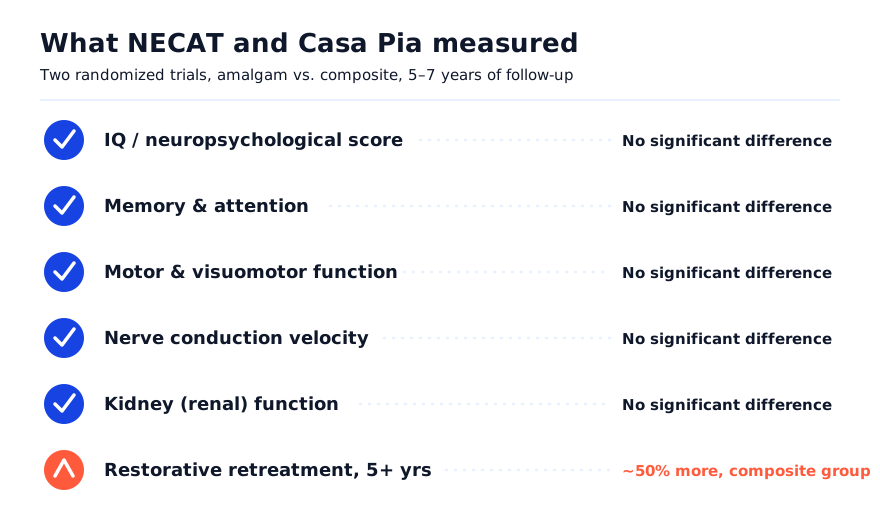
What NECAT and Casa Pia actually measured, and the one place a real difference turned up, in the direction most people don't expect. Data from 2, 3.
Where the evidence is thin
- Both landmark RCTs are in children. Adults, who carry most amalgam restorations, are covered mostly by observational and mechanistic data, not a trial at this scale.
- No RCT exists in pregnant women, for obvious ethical reasons: the FDA's precaution there rests on biological plausibility, not a NECAT-style trial.
- Multiple-comparisons noise is real. Cochrane's own authors flag that measuring dozens of outcomes makes some hit "significance" by chance, which cuts against treating any stray positive finding elsewhere as solid.
- The materials have moved on. These trials placed 2006-era composite; modern resin chemistry may have narrowed or widened the failure-rate gap since.
- Nobody has studied "detox" removal as treatment. Every trial here tested placing restorations, not removing intact ones, and removal carries its own documented risk: a temporary mercury spike plus tooth structure and pulpal risk.
What this means Monday morning
- Amalgam remains a legitimate, evidence-backed choice for the general population. You can tell a worried patient, accurately, that the best trial data doesn't show harm.
- For the FDA's named groups: pregnant or nursing patients, children under six, neurological disease, kidney impairment, known mercury sensitivity: default to composite or glass ionomer when the site allows it.
- Don't remove intact, asymptomatic amalgam for "detox." No evidence of benefit, a documented mechanism of harm during removal itself.
- Already replacing an amalgam for an unrelated reason: fracture, recurrent decay, an esthetic request? Reasonable moment to switch materials for a risk-group patient. The clinical need is the trigger, not a manufactured concern.
- Frame it as shared decision-making, the way you would any other case presentation: cavity depth, moisture control, cost, and what the patient wants to look at all belong in the choice alongside this data.
The bottom line
The strongest human evidence available (two independent multi-year randomized trials in children plus a 2021 Cochrane review) does not show clinically meaningful harm from dental amalgam in the general population. Regulators still steer a short list of higher-risk groups toward alternatives, and a treaty is phasing amalgam down for environmental reasons, and neither is new evidence the fillings already placed are hurting anyone. Precaution for a few, safety for the rest, and an evidence-first conversation beats either extreme the internet keeps offering.
References
- Worthington HV, Khangura S, Seal K, et al. Direct composite resin fillings versus amalgam fillings for permanent posterior teeth. Cochrane Database Syst Rev. 2021;8(8):CD005620. DOIPubMed
- Bellinger DC, Trachtenberg F, Barregard L, et al. Neuropsychological and renal effects of dental amalgam in children: a randomized clinical trial. JAMA. 2006;295(15):1775-1783. DOIPubMed
- DeRouen TA, Martin MD, Leroux BG, et al. Neurobehavioral effects of dental amalgam in children: a randomized clinical trial. JAMA. 2006;295(15):1784-1792. DOIPubMed
- U.S. Food and Drug Administration. Dental Amalgam Fillings. Updated February 18, 2021. Source
- Scientific Committee on Emerging and Newly Identified Health Risks (SCENIHR), European Commission. The Safety of Dental Amalgam and Alternative Dental Restoration Materials for Patients and Users. Final Opinion, 2015. Source
- United Nations Environment Programme. Minamata Convention on Mercury. Entered into force August 2017. Source
This article summarises published research for clinicians. It is not a substitute for your own reading of the studies or your clinical judgment.
Questions
What dentists ask about this.
Is amalgam safe, or does it cause mercury poisoning?
The strongest human evidence (two independent multi-year randomized trials in children plus a 2021 Cochrane review) found no clinically meaningful difference in IQ, memory, kidney function, or nerve conduction between kids restored with amalgam and kids restored with composite.
Why does the FDA still recommend some patients avoid amalgam?
The FDA strongly encourages non-amalgam restorations for pregnant or nursing women, children under six, people with pre-existing neurological or kidney disease, or known mercury sensitivity, but it is explicit that it is not recommending removal of existing amalgam fillings in good condition, since removal itself temporarily raises mercury exposure.
Does the Minamata Convention mean amalgam is unsafe?
No. The treaty is an environmental phase-down concerning mercury entering water, soil, and air through extraction and disposal, not a finding about vapor exposure from a filling already in a molar. It's an environmental instrument, not a patient-safety recall.
Should I remove a patient's old amalgam filling for 'detox' reasons?
No. There is no evidence of benefit, and removal carries a documented risk: a temporary increase in mercury vapor exposure plus loss of healthy tooth structure. Only replace an amalgam when there's an unrelated clinical need, such as fracture or recurrent decay.
Does composite fail more often than amalgam?
Yes. A Cochrane review pooling two trials in 921 children found composite failed almost twice as often as amalgam (risk ratio 1.89), with more than double the secondary-caries risk.
Key terms
Where to next
Clinical judgement is half of it. The other half is the business around the chair.