You're Making It Too Easy for Patients to Cancel. Here's the Fix.
Cheerful, no-resistance rescheduling trains patients to cancel on you. A Stop-Light system and printable scripts to protect your schedule without being rude.
Key Takeaways
- You trained this behavior. A cheerful, no-resistance "no problem, we'll move you" teaches patients that your schedule is the easiest commitment in their life to break.
- Resistance isn't rudeness. Appropriate friction ("Oh no, what happened?" instead of instant agreement) matches the seriousness of a clinical appointment without being confrontational.
- The Stop-Light system sorts your response by what's actually at risk: routine hygiene gets low resistance, near-term hygiene gets moderate resistance, doctor time and high-production blocks get maximum resistance.
- An empty chair doesn't pause your costs: staff, rent, and lab commitments run whether or not a patient is in the room. Only the production disappears.
- Track it, don't guess. Your broken-appointment rate is a number, and it belongs on the same dashboard as production and collections.
Every time a patient calls to cancel, they're resolving a small conflict: two obligations, one block of time, somebody has to lose. If your front desk cheerfully says "no problem, we'll get you in next week," you've just told them who loses. Not them. You've made your own schedule the softest commitment in their life: easier to walk back than a haircut, easier than a returned library book.
We call this good customer service. It's actually the opposite. Every time we absorb a cancellation without any friction, we teach the patient that our time, our team's time, and our overhead don't really matter. If you want the bleeding in your schedule to stop, you have to stop being so easy to cancel on.
The Cost Nobody Puts on the Schedule
A cancellation isn't just a hole in the day. You walked in ready for a 90-minute crown prep (the assistant's set up, the lab case is checked in, you're mentally in it), and then the phone rings and all of that evaporates. The frustration doesn't stay contained to one operatory; it spreads through the team, and it happens on a day when your fixed costs kept running exactly as planned.
That's the part worth sitting with. Your overhead doesn't know the chair is empty. Staff are still clocked in, rent and utilities don't pause, and any lab work already committed for that visit is already committed. The only thing that disappears is the production that chair was supposed to generate, and with it, the next patient who might have filled that slot instead.
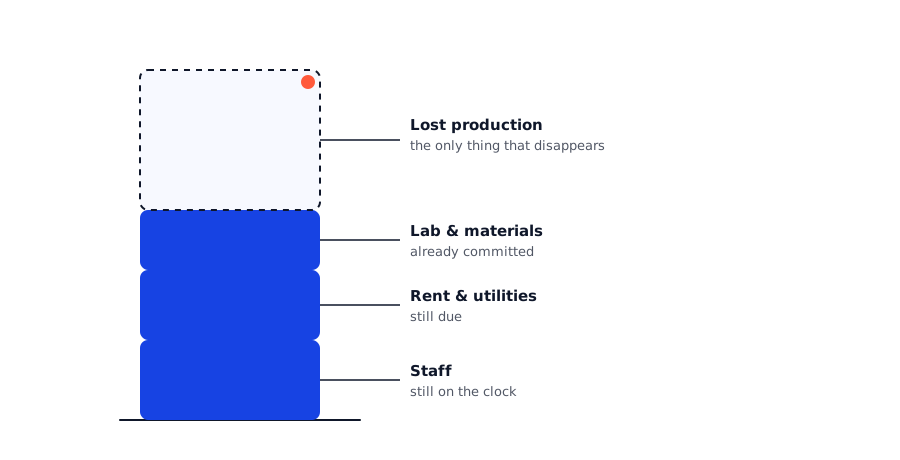 Illustrative: categories of cost, not dollar amounts. Run your own practice's numbers at the daily break-even calculator.
I'll tell you what I tell every practice I coach: a single chronic no-show slot can represent a six-figure swing in a year's collections. That's my estimate from watching this play out across the practices I've run and coached, not a published statistic, and it's exactly why I'd rather hand you the calculator than a number you can't verify. Plug in your own overhead and your own average production per hour at /tools/daily-break-even and see what one empty chair a day actually costs you. For the operational side of finding where that capacity is really going, dental-practice-kpis is the place to start tracking it alongside the rest of your numbers.
From Order-Takers to Guardians of the Schedule
The team's mindset has to shift from taking orders to protecting the schedule. That starts with basic human behavior: when a patient is choosing between picking up a kid early and keeping a filling appointment, they're looking for whichever commitment offers the least friction. If one side says no and the other says "no problem," the appointment loses every time.
This doesn't mean being rude. It means introducing resistance that actually matches how serious the appointment is. The moment a patient says they need to reschedule, the correct first response isn't agreement. It's concern: "Oh no, what happened?" That single question raises the bar. It signals that canceling a clinical appointment ought to require a real reason, and it opens the door to problem-solving instead of paperwork: "Is there any way we could still make that time work?" You'd be surprised how often the answer becomes "let me see what I can do," simply because the exit wasn't left wide open.
This is where dental teams (full of natural people-pleasers) tend to struggle, because resistance feels unkind. Reframe it: letting a patient casually cancel restorative care isn't kindness, it's neglect. The schedule is a clinical prescription, not a social calendar.
The Stop-Light System
To make the right level of resistance automatic instead of a judgment call under pressure, sort every appointment into one of three categories before the conversation ever happens.
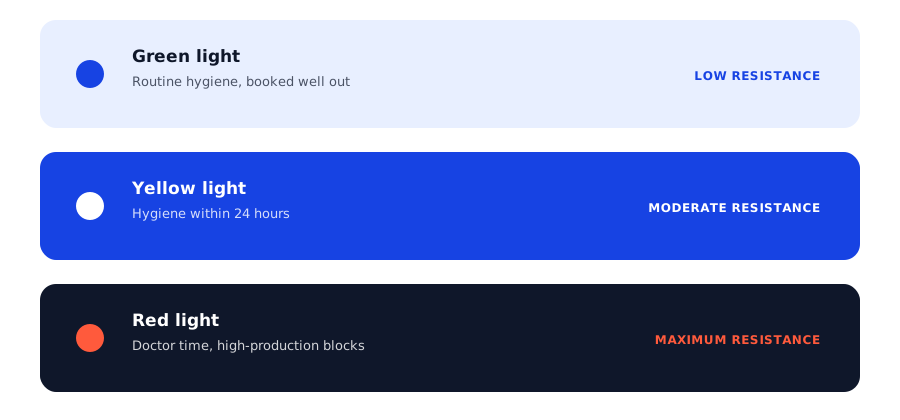 Illustrative system, not a chart of measured data.
| Light | What it covers | Resistance level |
|---|---|---|
| Green light | Routine hygiene, booked well out | Low: accommodate normally |
| Yellow light | Hygiene within 24 hours | Moderate: problem-solve before rebooking |
| Red light | Doctor time, high-production blocks | Maximum: protect the reserved time |
Green-light appointments are low-risk: routine cleanings booked far out. Low resistance is appropriate here. Don't manufacture friction where none is needed. Yellow-light appointments are hygiene visits inside a 24-hour window; this calls for moderate resistance and a genuine attempt to keep the time. Red-light appointments are doctor time and high-production blocks, and they get maximum resistance, because that's where the six-figure swing actually lives.
None of this works unless the team can say the words out loud before they need them live. Role-play it in a huddle until it's not stiff:
Script: protecting a red-light appointment "Dr. Smith has reserved this time specifically for you." "The room is prepped and the materials are already pulled." "Since this was part of a reserved clinical block, it may be several weeks before we can find another opening like it."
Script: the reschedule pivot Patient: "I need to pick up my kid, can we move this?" Team: "Is there anyone else who could grab them today, so we can keep this time?" or "Would arriving a little late work better than rescheduling entirely?"
The pivot matters even more than the opening line. If a patient raises a conflict, the reply isn't "okay, when should we rebook you?" That's surrender dressed up as service. It's a genuine attempt to solve the actual problem first.
Build the Value Before You Ever Need the Script
The easiest cancellation to prevent is the one that never gets scheduled as "just an appointment" in the first place. Too many assistants close out a visit with "we'll see you in two weeks for that crown", which builds zero value and sounds exactly as skippable as it is. Compare that to: "Dr. Smith has reserved a 90-minute block to protect this tooth before that fracture gets worse." One is a slot on a calendar. The other is prevention with a deadline.
Do this everywhere. SRP stops bone loss. A root canal eliminates an active infection. An implant prevents further resorption. Give every appointment a purpose beyond the clock, and patients are far less likely to let something minor bump it.
Language matters just as much in your automated systems. A confirmation text that reads "Reply C to confirm or call to reschedule" is an engraved invitation to cancel. Try instead: "We're looking forward to seeing you at your reserved time, Tuesday at 2:00 PM." No visible exit sign. If a patient genuinely needs to change it, they can still call. You just don't need to advertise the off-ramp in every text you send.
And at checkout, retire the sentence "if anything comes up, just let us know and we'll move it." It quietly tells the patient the time was never really theirs to protect. Replace it with something closer to: "We've reserved this time specifically to keep your oral health on track. We look forward to seeing you."
No-Shows Need a Different Script Than Cancellations
Don't wait until the end of the day to address a no-show. Call ten minutes after the appointment time, and lead with concern, not accusation: "Dr. Smith was worried something might have happened on the way in: please give us a call so we know you're okay." That reframes a missed visit as a human moment instead of a billing problem, and it's a very different conversation from a same-day cancellation.
When the patient does come back in, be direct without being punitive: "When someone doesn't show, it means we couldn't help another patient who may have really needed that time." That's accountability, delivered plainly.
If you have a genuinely chronic offender, change the arrangement rather than keep absorbing it: "We'd love to keep caring for you, but because your schedule has been unpredictable, we're not able to reserve time in advance right now. We can see you same-day instead." That's a boundary, not a punishment, and it protects the block for patients who will actually show up for it.
Track It So It Sticks
None of this holds without measurement. Know your broken-appointment rate. Know it by provider, by day of week, and by which team members are best at saving a red-light slot on the phone. Share the number with the team, not to shame anyone, but to connect the behavior to the outcome: one saved crown prep is real money toward raises, equipment, or the next hire. Checklists that build this review into the weekly rhythm keep it from quietly sliding, and it's exactly the kind of accountability a well-trained office manager should be running without you having to ask.
The Bottom Line
A schedule with no friction in it isn't a convenience. It's a system quietly teaching patients that your time is optional. The Stop-Light system gives your team permission to push back in proportion to what's actually at stake, the scripts give them the words to do it without sounding harsh, and the tracking makes sure it's a system and not a mood. Run your own numbers on what an empty chair costs you at the daily break-even calculator, then decide how much resistance that number is worth building into your front desk's next phone call.
If protecting the schedule is one piece of a bigger operational gap, the 90-Day Dental Practice Growth Plan walks through the full sequence (attracting patients, scheduling, diagnosis, case acceptance, and completion), so fixing one leak doesn't just reveal the next one.
Questions
What dentists ask about this.
How do I get patients to stop canceling dental appointments so easily?
Introduce resistance that matches the seriousness of the appointment instead of agreeing immediately. Respond to a cancellation request with concern ('Oh no, what happened?') instead of 'no problem, we'll move you,' and try to solve the actual conflict before rebooking.
What is the Stop-Light system for handling appointment cancellations?
It sorts every appointment into green, yellow, or red light before the conversation happens: routine hygiene booked well out gets low resistance, hygiene within 24 hours gets moderate resistance, and doctor time or high-production blocks get maximum resistance because that's where the real financial swing lives.
Does an empty dental chair actually cost the practice money?
Yes. Overhead doesn't know the chair is empty: staff are still clocked in, rent and utilities don't pause, and any lab work already committed for the visit stays committed. Only the production that chair was supposed to generate disappears.
How should a front desk handle a patient who no-shows an appointment?
Call about ten minutes after the appointment time and lead with concern, not accusation: checking that nothing happened on the way in. When the patient returns, be direct about the impact: a missed visit meant another patient who needed that time couldn't be seen.
How do I stop patients from treating my schedule as easy to change?
Build value into every appointment when you schedule it (describe what the visit accomplishes clinically instead of just naming a procedure), and remove the invisible exit sign from confirmation texts and checkout language that implicitly invites rescheduling.
Key terms
Where to next
If this is the problem you are living with, the course covers the whole system.