
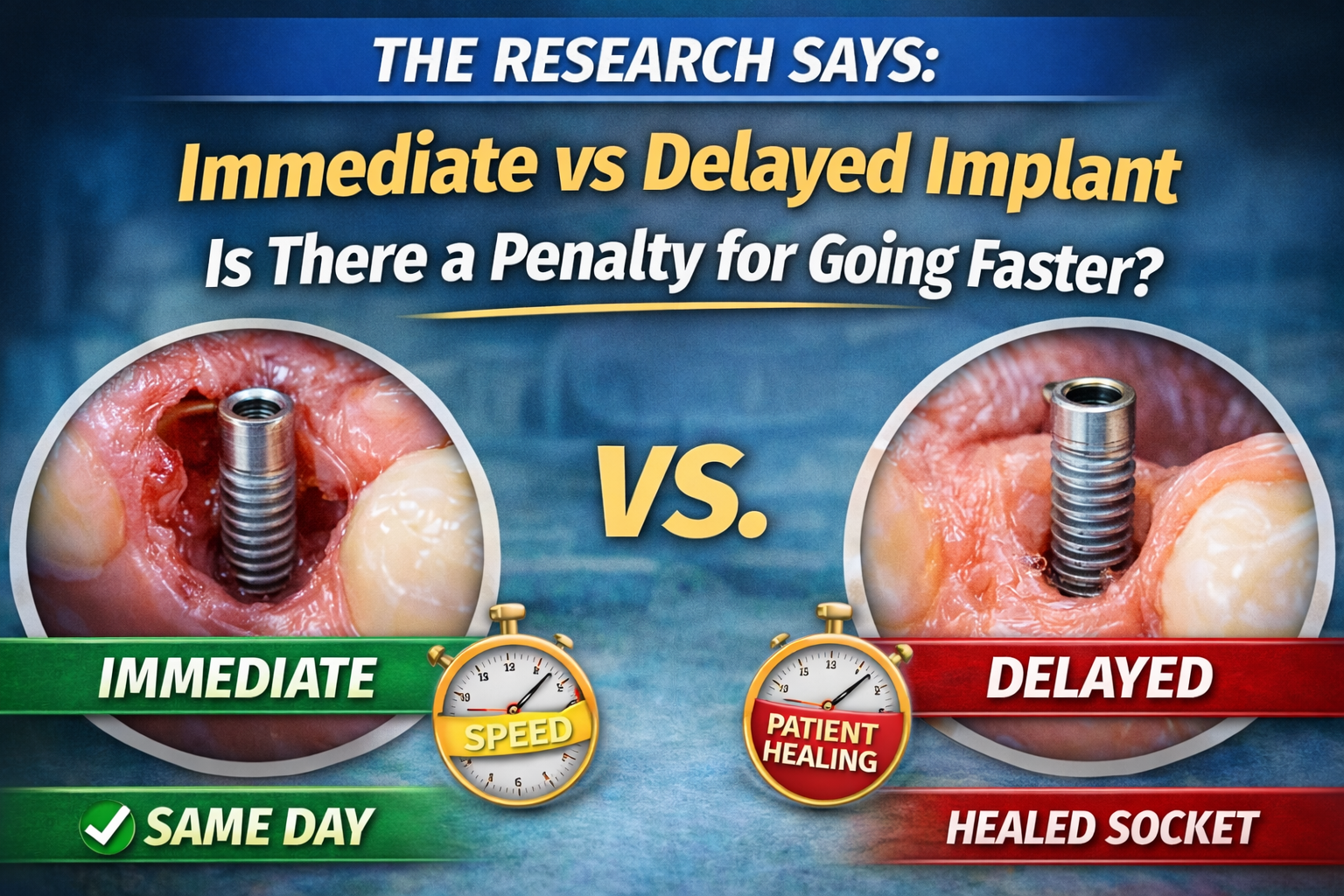
We all feel the pressure. The patient wants a tooth now, and technology promises we can deliver it faster than ever. But is there a hidden penalty for speed? Does placing an implant into a fresh extraction socket on the same day compromise its long-term survival compared to the traditional, delayed approach?
If you’ve ever felt confused by the conflicting research on this topic, you aren’t alone. One study will tell you immediate implants are 98% successful, while your own clinical experience might tell a different story.
My perspective is that the devil is in the details, and most dentists aren’t being shown the full picture. In this edition of The Research Says, we are going to critically dissect the data to decide when to go immediate and when to hit the brakes.
Insight #1: The Fatal Flaw in “Survival” Studies
To understand the data, we first have to expose a critical flaw in how research defines “survival.” When a sales rep quotes a 98% success rate, you need to ask: Successful at what?
In many large meta-analyses, the criteria for survival is simply: “Is the implant still physically in the patient’s mouth?”
We all know this is a ridiculously low bar. A failing implant with 5mm of bone loss and peri-implantitis is technically “in the mouth,” but none of us would call that a success. When you apply a clinically relevant definition—no mobility, no pain, and less than 2mm of bone loss—the numbers change dramatically.
Insight #2: The 6-Year Reality Check (The Penalty)
When we look at short-term data (1-2 years), immediate and delayed implants look similar. But a recent study published in Frontiers in Dental Medicine (2025) reveals a staggering difference at the 6-year mark.
Total Survival at 6 Years:
- Delayed Placement: 81%
- Immediate Placement: 53%
When the researchers broke it down by arch, the data became even more concerning. In the maxilla, the survival rate for immediate implants plummeted to only 40%.
In my opinion, a 40% survival rate at six years is a clinical catastrophe. While initial results look good, the biomechanical compromises of immediate placement in a less-than-ideal site eventually catch up with us.
Watch the full, in-depth guide.
Insight #3: Infections and Gap Grafting
The research also challenges some of our oldest dogmas regarding pathology and grafting.
Can you place into a periapical lesion? Traditionally, we were taught that a PA lesion is an absolute contraindication. However, a 2023 study in BMC Oral Health suggests otherwise. They found that with thorough debridement (and potentially antibiotics), immediate implants in sites with chronic lesions had survival rates of 95-97%. The presence of a chronic lesion may not be the red light we thought it was.
Do you need to graft the gap? A systematic review from 2022 answered this definitively.
- Survival: Grafting the gap made no difference in whether the implant survived.
- Bone Stability: However, grafting made a huge difference in bone preservation. Sites that were grafted had 54% less horizontal bone loss.
- The Takeaway: You graft the gap not for survival, but for the long-term esthetic stability of the tissue.
Clinical Takeaway: The Risk Assessment Protocol
So, how do you apply this tomorrow? The decision must be based on risk assessment, not speed.
Scenario A: The High Risk (DELAY)
- Factors: Posterior maxilla, soft bone, systemic factors (osteoporosis), heavy occlusion.
- Verdict: You should absolutely lean toward delayed placement. The “penalty” for speed in the maxilla is simply too high.
Scenario B: The Low Risk (IMMEDIATE)
- Factors: Mandible, dense bone, excellent primary stability, healthy patient.
- Verdict: Immediate placement is a relatively safe and predictable procedure.
- Rule: Always graft the gap and place slightly subcrestal to account for remodeling.
References & Further Reading
- Zhu Y, et al. (2024). Immediate versus delayed implant placement in molar extraction sockets: A systematic review and meta-analysis. J Prosthodont Res.
- Cheng Y, Lai Z, Yu W. (2025). Influencing factors and survival rates in immediate vs delayed dental implant placement: a six-year retrospective analysis. Frontiers in Dental Medicine.
- Cosyn J, et al. (2021). The long-term clinical outcome of immediate implant placement in sockets with and without periapical pathology. J Clin Periodontol.
- Seyssens L, Eeckhout C, Cosyn J. (2022). Immediate implant placement with or without socket grafting: a systematic review and meta-analysis. Clin Implant Dent Relat Res.