
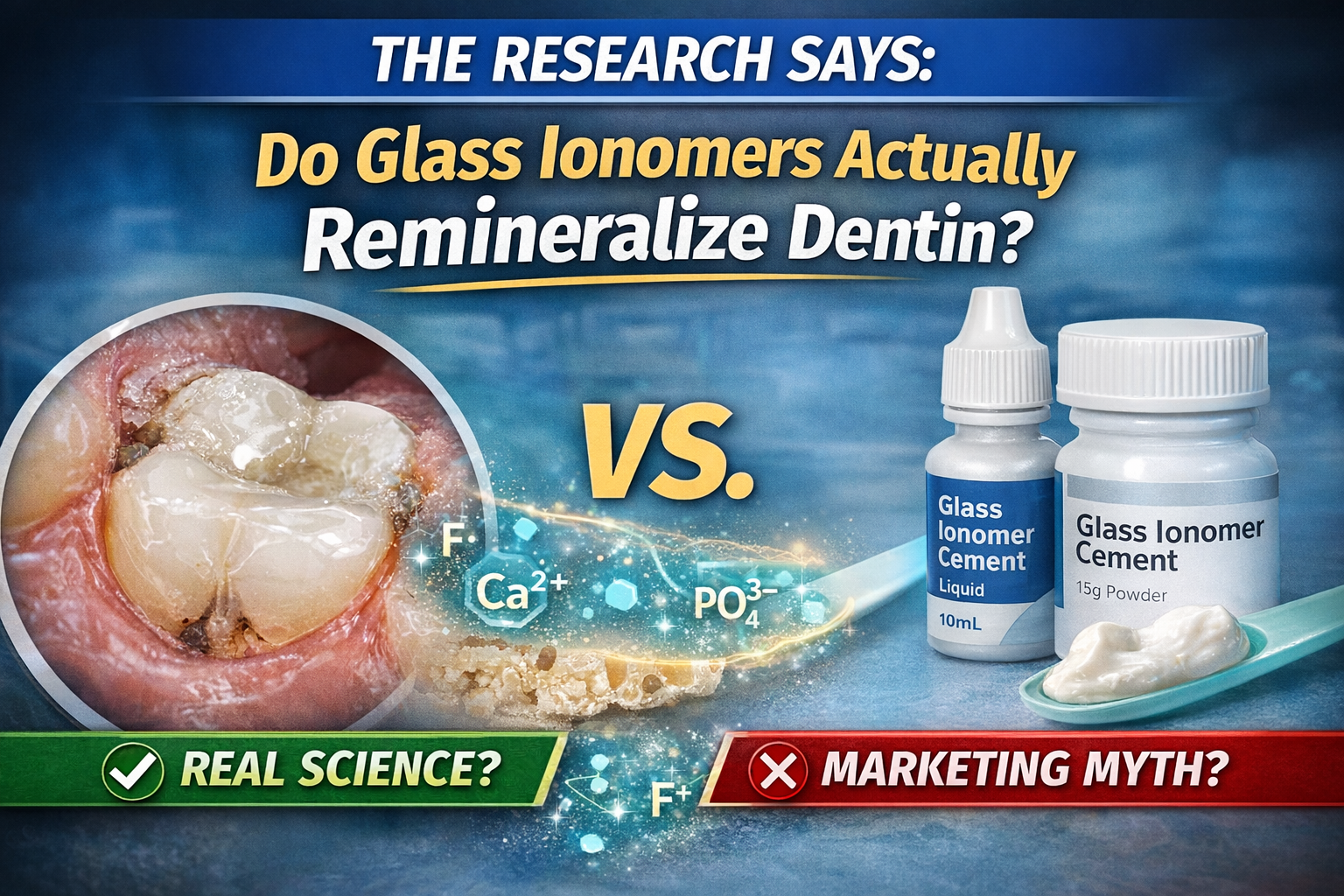
You’ve probably heard this claim a hundred times: “Glass ionomers actually remineralize dentin.”
It’s one of those phrases that sounds amazing—almost too good to be true. A filling material that doesn’t just fill the hole but actually helps heal the tooth? But does it really happen inside the tooth? Or is that just a story we’ve been repeating since the Fuji marketing reps started saying it?
This question sits right at the intersection of biology and restorative dentistry. When you are treating a deep cavity and performing selective caries removal, you are leaving behind “affected dentin”—tissue that is partly demineralized but structurally sound. The big question is: if we seal that dentin properly with a glass ionomer (GIC), can it get stronger again?
In this edition of The Research Says, we are digging into the chemistry and the latest studies to find out if GICs are truly bioactive or just nice-sounding marketing.
How It Works: The “Ion Exchange Zone”
To understand the research, we first have to understand the mechanism. Glass ionomers harden through an acid-base reaction. During this process, they release ions—mainly fluoride, calcium, and strontium.
These ions don’t just stay in the filling. They migrate across the boundary into the tooth, creating what researchers call an ion-exchange zone.
- The Theory: In the presence of moisture, these ions diffuse into the partially demineralized dentin. If the collagen framework is intact, the ions rebuild lost mineral, essentially re-hardening the tooth from the inside out.
What The Evidence Shows
1. The Systematic Review (2023)
A review by Ghilotti et al. in the Journal of Functional Biomaterials looked at over 20 studies testing conventional and resin-modified glass ionomers (RMGIs). The Finding: Across the board, they found consistent increases in microhardness and calcium/phosphate levels beneath the fillings. Both traditional and RMGIs performed about the same, proving that the material actively promotes mineral gain.
2. The Head-to-Head Comparison (2024)
Kuru et al. published a study in BMC Oral Health directly comparing Biodentine (a calcium silicate) and Fuji IX (a classic GIC). The Finding: Both materials showed significant increases in calcium and phosphate in the underlying dentin compared to controls. While Biodentine had slightly more mineral gain, Fuji IX performed exceptionally well—far better than doing nothing. Both materials actively “feed” ions back into the tooth.
Watch the full, in-depth guide.
3. Visual Proof of the Bond (2022)
Hoshika and colleagues used high-powered microscopy to examine the interface between GIC and dentin. The Finding: They found a true ion-exchange layer. On the GIC side, ions were depleted; on the tooth side, a new mineral-rich layer had formed. This chemical bond is something composites simply cannot replicate.
Clinical Application: The “Bioactive” Protocol
So, what does this mean for your daily restorative workflow? If you are doing selective caries removal (stopping at leathery dentin to avoid pulp exposure), a glass ionomer is biologically the right move.
The Protocol:
- Excavate: Remove infected dentin, stop at firm/leathery affected dentin.
- Do Not Over-Dry: GICs need a little moisture for the ion exchange.
- Seal: Place a GIC or RMGI liner/base immediately.
- Restore: You can sandwich with composite or leave as a temporary if needed.
The goal isn’t just to cover the dentin; it is to create an ion-rich environment that allows it to heal.
Conclusion: It’s Not Just Marketing
Based on everything we know right now: Yes, glass ionomers really do remineralize caries-affected dentin.
They make it harder. They increase its mineral content. They create a chemical bond through that ion-exchange layer. While newer calcium-silicate materials (like Biodentine) are excellent, glass ionomers remain a powerhouse because of their fluoride recharge ability and long-term chemical stability.
A well-sealed glass ionomer restoration doesn’t just survive—it helps the tooth recover. That is why, for deep lesions, biology beats simple mechanics every time.
References & Further Reading
- Ghilotti J, et al. (2023). Remineralization potential of three restorative Glass Ionomer cements: an in vitro study. Journal of Functional Biomaterials.
- Kuru E, Altunsoy M, Kuru B. (2024). Comparison of remineralization ability of tricalcium silicate and of glass ionomer cement on residual dentin: an in vitro study. BMC Oral Health.
- Hoshika S, et al. (2022). Interfacial Characterization of a Conventional Glass-Ionomer Cement after Functioning for 1 Year In Vivo. Scientific Reports.
- Nicholson JW, Sidhu SK, Czarnecka B. (2023). Fluoride exchange by glass-ionomer dental cements and its clinical effects: a review. Biomaterial Investigations in Dentistry.