

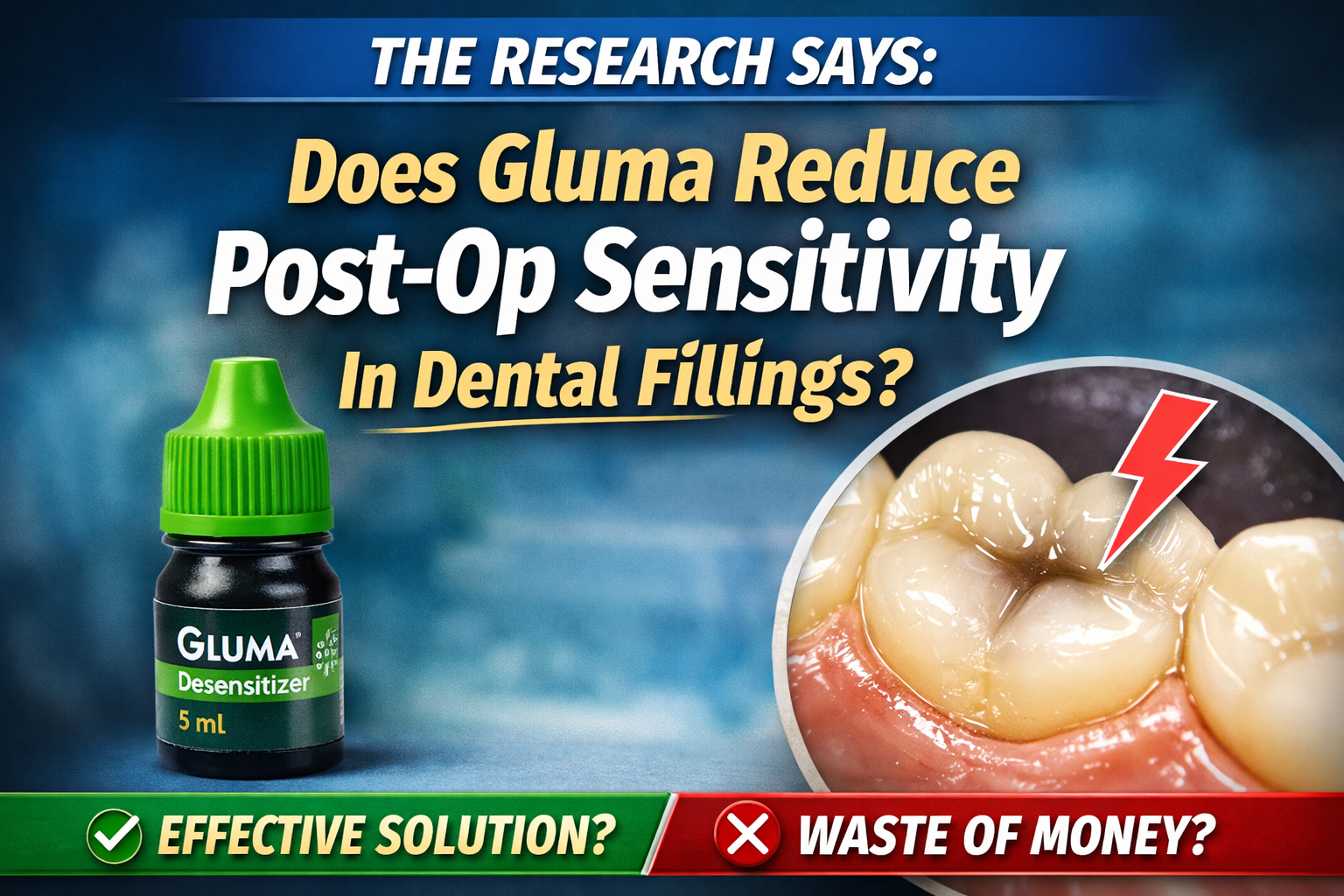
Welcome to the debut of The Research Says, a new series where we take our biggest, most debated clinical questions and cut through the anecdotes to find a definitive, actionable answer.
We are starting with a question I see constantly in forums and study clubs: Does using a desensitizer like Gluma actually help with post-operative sensitivity in composite fillings?
Some clinicians swear it is their “magic bullet.” Others think it is a waste of money. Today, we are going to look at what the highest-level research actually says to determine if you should be reaching for that bottle or saving your cash.
The Science: Hydrodynamic Theory & Shrinkage
Before looking at the data, we have to understand the mechanism.
- Hydrodynamic Theory: Dentin is filled with microscopic fluid-filled tubules. When a stimulus (cold, pressure) hits an open tubule, the fluid moves, yanking on the nerve and causing pain. The goal of restorative dentistry is to create a hermetic seal to stop this movement.
- Polymerization Shrinkage: As composite cures, it shrinks, creating micro-gaps that allow fluid movement.
How Gluma Works: The active ingredients are Glutaraldehyde and HEMA. The glutaraldehyde coagulates the proteins in the dentinal fluid, forming plugs inside the tubules. The HEMA helps form a resinous seal. Mechanically, the theory is sound. But does it matter clinically?
The Conflict in the Data
If you just glance at the literature, it looks contradictory.
- The Positive Studies: A 2022 RCT in Cureus and another in the Indian Journal of Dental Research found Gluma significantly outperformed controls at one week and one month.
- The Trap: These were generally shorter-term studies. When we look at the hierarchy of evidence, we need to find the “Gold Standard”: long-term, split-mouth, randomized controlled trials.
Watch the full, in-depth guide.
The Gold Standard: What the Best Research Says
When we look at the top-tier journals, the story changes completely.
1. Journal of Dentistry (2022)
- Study: A 12-month, split-mouth trial of 220 posterior composites.
- Finding: Applying Gluma did not significantly reduce post-operative sensitivity compared to the control group, regardless of whether they used total-etch or self-etch.
2. Dental Materials (2023)
- Study: A massive 24-month study of 228 deep posterior composites—exactly the cases where you’d expect a desensitizer to help.
- Finding: No significant difference. After two years, the restorations with Gluma performed no better than those bonded with just a high-quality adhesive.
The Verdict
When you synthesize the highest quality research, the conclusion is clear: With a good bonding technique, Gluma does not make a significant clinical difference.
A well-placed, well-cured modern adhesive system is more than capable of creating a complete seal on its own. Gluma might act as a safety net if your technique is imperfect, but it is not a substitute for excellent dentistry.
The Actionable Takeaway
So, what should you do Monday morning? Stop buying the bottle.
Instead, take that money and invest it in the things that do improve outcomes:
- A High-Quality Curing Light: Ensure you are getting a complete cure.
- Magnification: See your margins with absolute clarity.
- Continuing Education: Master your adhesive protocols and occlusal adjustments.
Focusing on your fundamental technique is a far more reliable solution to sensitivity than relying on an adjunct that the best science shows provides little benefit.
References & Further Reading
- Hanzen TA, et al. (2023). Effect of a glutaraldehyde-based desensitizer on the clinical performance of bulk-fill resin composites: A 24-month randomized clinical trial. Dental Materials.
- de Oliveira ILM, et al. (2022). Effect of a glutaraldehyde-containing desensitizer on postoperative sensitivity of posterior composite restorations: A randomized clinical trial. Journal of Dentistry.
- Sayed ME, et al. (2022). Efficacy of Different Desensitizing Agents in Controlling Postoperative Sensitivity… Polymers.