
Every few years, dentistry rediscovers something so effective and so simple that it almost feels uncomfortable to believe. Silver Diamine Fluoride—or SDF—is one of those things. It costs just a few dollars, takes less than a minute to apply, and has been shown to stop decay in its tracks.
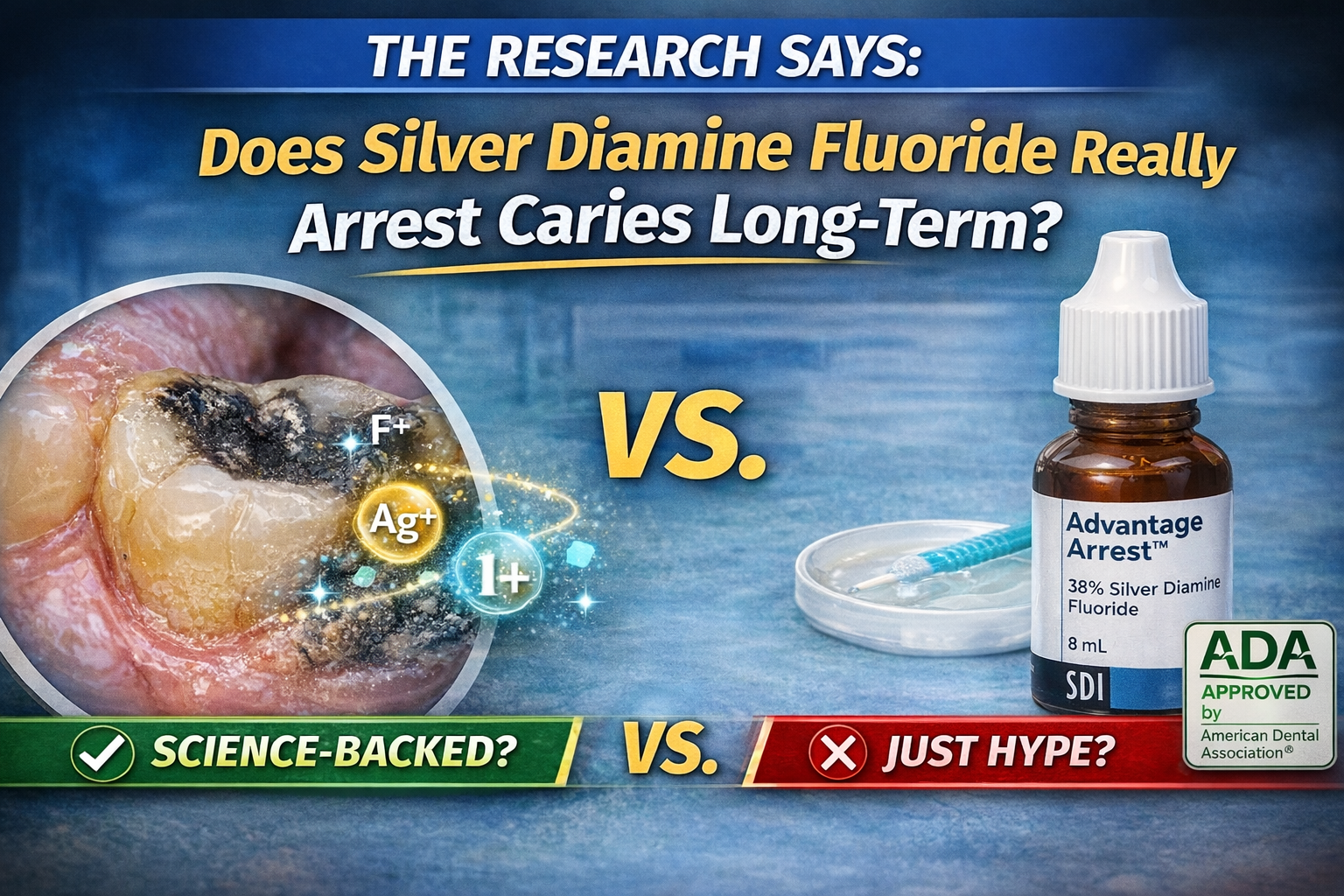
But here’s the real question: Does it actually arrest caries long-term, or is this just a temporary fix that stains teeth black and buys us time?
If you’ve ever had a high-risk patient—a child with rampant decay, an elderly patient with root caries, or a special-needs patient who just can’t tolerate restorative treatment—you know the power of having a non-invasive way to stop the disease. But as clinicians, the question isn’t whether it works short-term. It’s whether it holds up.
In this edition of The Research Says, we are looking at the mechanism, the meta-analyses, and the long-term data to find the answer.
The “Zombie Effect”: How It Works
SDF is a clear liquid that combines silver, fluoride, and ammonia.
- Silver: Antimicrobial agent that kills bacteria responsible for caries.
- Fluoride: Promotes remineralization (at 44,000 ppm, it has roughly double the fluoride of varnish).
- Ammonia: Keeps the solution stable and alkaline.
When placed on a lesion, the bacteria die, and the soft dentin hardens. But the most interesting part is what scientists call the “Zombie Effect.” The dead bacteria that have absorbed silver actually continue killing live bacteria nearby. This creates a sustained antimicrobial zone that keeps protecting the tooth even after the application is complete.
What The Evidence Shows
Let’s look at the major systematic reviews and trials that have shaped our understanding.
1. The Gao Review (2016)
One of the first major systematic reviews analyzed 16 clinical trials involving over 2,000 children. The Finding: SDF arrested about 81% of active carious lesions in primary teeth. This was the wake-up call that proved SDF wasn’t just folklore; it was real science.
2. The Chibinski Meta-Analysis (2017)
Comparing SDF to alternative treatments and placebos, this study found SDF was 89% more effective at arresting cavitated lesions after 12 months. That is a number we rarely see in preventive dentistry.
3. The CariedAway Trial (2023)
This massive real-world study in NYC public schools involved nearly 3,000 children. Researchers compared SDF plus fluoride varnish against traditional glass-ionomer sealants. The Finding: After two years, SDF performed just as well as sealants. The prevention of new caries was virtually identical (~81% for both groups). The Implication: SDF achieved the same results as sealants without drilling, without isolation, and at almost no cost. That is practice-changing.
Watch the full, in-depth guide.
The Long-Term Data
A recent systematic review in Frontiers in Oral Health pulled together ten years of studies. It confirmed that SDF consistently arrests decay and reduces new lesions, especially when applied twice a year at 38% concentration.
While studies beyond three years are limited, every trial so far shows that arrested lesions stay hard and stable as long as reapplication continues.
Limitations: It’s Not Magic
SDF is powerful, but it has trade-offs:
- The Black Stain: SDF permanently discolors decayed dentin (but not sound enamel). This is the visual confirmation of arrest, but it can be an aesthetic concern in the anterior zone.
- Not Restorative: It stops the rot, but it doesn’t rebuild the tooth. This is where the SMART technique (Silver-Modified Atraumatic Restorative Treatment) comes in—covering the arrested lesion with Glass Ionomer to restore form and function.
- Reapplication: It is not “one and done.” Failure rates exist (10-30%), so monitoring and reapplication every 6 months are crucial for success.
Who Benefits Most?
- Children: Specifically those with Early Childhood Caries (ECC).
- Elderly: Excellent for root caries.
- Special Needs: Patients who cannot tolerate traditional restorative treatment.
- Medically Compromised: Patients where anesthesia or drilling poses a risk.
The Protocol: How to Use It
The highest-quality evidence supports this simple protocol:
- Concentration: Use 38% SDF.
- Frequency: Apply twice per year.
- Application: Dry the tooth, isolate with cotton, apply a small amount with a microbrush for one minute. No rinsing required.
- Cover (Optional): Apply fluoride varnish over the top to mask the taste and seal it in.
Conclusion
So, does Silver Diamine Fluoride really arrest caries long-term? The research says yes—and impressively so.
It’s not pretty, but it’s powerful. For high-risk, underserved, or medically fragile patients, it is a paradigm shift in disease control. The evidence is clear: it works, it’s safe, and when used correctly, it works long-term.
References & Further Reading
- Gao SS, et al. (2016). Clinical Trials of Silver Diamine Fluoride in Arresting Caries among Children: A Systematic Review. JDR Clin & Translational Research.
- Ruff RR, et al. (2023). Effect of Silver Diamine Fluoride on Caries Arrest and Prevention: The CariedAway School-Based Randomized Clinical Trial. JAMA Network Open.
- Seifo N, et al. (2019). Silver diamine fluoride for managing carious lesions: an umbrella review. BMC Oral Health.
- American Dental Association (ADA). Silver Diamine Fluoride (SDF) – Professional Resource.