
Here’s a question that can make even the best restorative dentists sweat: what do you do when you’re excavating a deep carious lesion and you’re staring at soft dentin that’s millimeters—perhaps microns—from the pulp?
Do you keep digging until you hit hard dentin and risk an exposure? Or do you stop, seal, and hope the pulp stays happy?
For years, the “right” answer was simple: take it all out. We were taught that any caries left behind was a guaranteed failure—that bacteria would keep marching toward the pulp like an invading army. But modern research is turning that thinking completely upside down.
Today, we are diving into the “The Research Says” series to tackle one of the most controversial decisions in restorative dentistry: Should you leave caries behind?
The Stakes: Vitality vs. Protocol
Deep caries management sits right at the crossroads between restorative and endodontic outcomes. One decision—just a few microns of dentin removal—can be the difference between a tooth that stays vital for decades and a tooth that ends up with a root canal or extraction.
There is a massive economic and emotional component here. Every time a patient ends up with post-op pain or a new RCT after a deep filling, it damages trust. It’s stressful for the clinician and expensive for the patient.
So, what is the smartest, most evidence-based way to protect the pulp? Before we look at the specific papers, we have to revisit the biology.
The Biological Paradigm Shift: Sealing vs. Sterilizing
Caries is not static; it is an active, dynamic process. But the game-changer in our understanding is that not all “infected” dentin behaves the same.
- Infected Dentin: The outermost, mushy, demineralized zone. It has no structural value and is loaded with bacteria. This needs to go.
- Affected Dentin: The inner zone closer to the pulp. It is partially demineralized but retains collagen structure.
The mechanism of success is simple: Bacteria need nutrients (sugar), moisture, and oxygen to survive. Once you isolate the nutrient source by sealing the lesion from the oral environment, the bacteria become dormant. They cannot keep doing damage.
The new paradigm is this: You don’t need to sterilize the tooth; you need to seal it.
What The Literature Says
Let’s look at the evidence hierarchy, from systematic reviews down to the clinical guidelines.
1. The Cochrane Review (2021)
The Cochrane Library is often considered the gold standard for evidence-based medicine. Their 2021 review pooled data from over a dozen clinical trials comparing complete, selective, and stepwise removal.
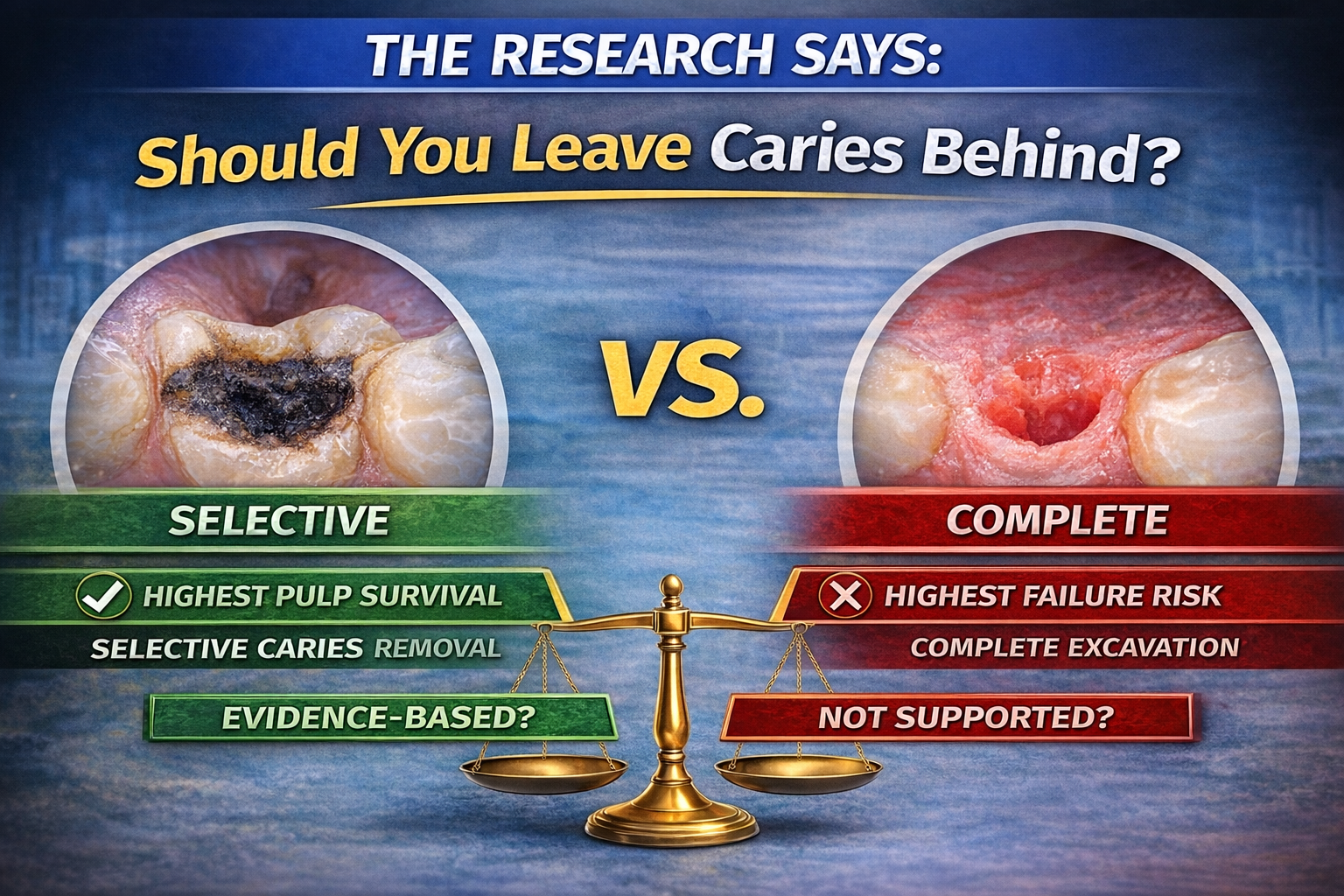
The Finding: For permanent teeth, selective caries removal came out on top. It offered the highest likelihood of keeping the pulp alive and the lowest risk of complications. Conversely, complete removal—the old-school “hard dentin only” method—had the highest risk of pulp exposure.
Key Citation: Schwendicke F, et al. “Interventions for treating cavitated or dentine carious lesions.” Cochrane Database of Systematic Reviews. 2021.
2. The ADA Clinical Practice Guideline (2023)
This is the most up-to-date recommendation from the American Dental Association, and it represents a significant departure from traditional teaching.
The Finding: The guideline explicitly recommends selective caries removal for deep lesions on vital teeth. It emphasizes that the dentist’s goal should be to remove caries from the periphery to achieve a sound margin (Clean Periphery), but to intentionally leave softened dentin pulpally to avoid exposure.
The ADA’s reasoning is that the key predictor of success is not the hardness of the dentin at the base of the cavity—it is the quality of the seal.
Key Citation: Slayton RL, Fontana M, et al. “Evidence-based clinical practice guideline on restorative treatments for caries lesions.” JADA. 2023.
Watch the full, in-depth guide.
3. Stepwise vs. Selective: The BMJ Open RCT (2019)
For a long time, “Stepwise Excavation” was the middle ground. You leave soft dentin, place a temporary, and come back months later to remove the rest. But is the second visit necessary?
The Finding: This Randomized Controlled Trial compared selective (one visit) vs. stepwise (two visits) in adult permanent teeth. After one year, both groups had high survival rates (~89%), but selective removal was more efficient and less burdensome.
The Takeaway: Stepwise excavation works, but it introduces the risk of re-entry. Every time you re-enter a tooth, you risk new contamination or pulp damage. If you can seal it well the first time, there is no biological reason to reopen the tooth.
Key Citation: Labib N, et al. “Selective versus stepwise removal of deep carious lesions in permanent teeth…” BMJ Open. 2019.
The Clinical Protocol: How to Execute Selective Removal
Based on the literature (including the foundational 2013 JDR meta-analysis by Schwendicke et al.), here is the evidence-based workflow for a deep, vital lesion:
- Verify Vitality: Ensure the tooth is asymptomatic (no lingering pain, no spontaneous ache).
- Clean the Periphery: You must remove all soft dentin at the margins. You need a rock-hard periphery to bond to.
- Conservative Excavation: As you approach the pulp and the dentin becomes leathery, stop. Do not chase hardness into the pulp chamber.
- Disinfect: Use a mild antimicrobial like sodium hypochlorite.
- Liner/Base: Apply a liner (Calcium Silicate or Resin-Modified Glass Ionomer) to encourage remineralization.
- The Seal: Place a permanent, bonded restoration immediately.
Conclusion: Don’t Fear the Soft Dentin
So, should you leave caries behind? Yes—if it’s deep and the tooth is vital.
The evidence from Cochrane, the ADA, and multiple RCTs points to the same conclusion: leaving some affected dentin pulpally, when properly sealed, leads to better pulp outcomes than removing it all.
We have moved beyond the dogma that “soft equals failure.” The real failure is a pulp exposure that could have been avoided. Next time you are deep in a lesion, remember: You aren’t “leaving decay,” you are preserving vitality.
The pulp isn’t the enemy; it’s a tissue that wants to survive. Your job is to give it a fighting chance by sealing it, not exposing it.