
Most dentists believe that buying an existing practice is the “safe bet” and starting from scratch is the “risky” one. It’s the conventional wisdom we’ve all been taught since dental school: find a retiring doc, buy their patient base, and you’re set for life.
But what if I told you that in today’s rapidly changing market, that math is often completely misunderstood?
There is a specific, often invisible financial trap hidden in many practice acquisitions that can cap your income potential for a decade. Conversely, a startup—if done correctly in the right market—can sometimes be the faster path to massive wealth.
I remember when I was facing this exact decision. It kept me up at night. The pressure is immense because you know this isn’t just a business decision; it’s a life trajectory decision. Choose the wrong path, and you could be grinding for years just to break even, wondering if you made a mistake that will cost you your retirement.
Today, I’m not going to give you fluffy advice about “following your heart.” We are going to look at the cold, hard math behind both options so you can make a decision based on profit, not just passion.
The Sticker Price Illusion
Let’s start by looking at the real cost to open the doors. When you look at the price tag, a startup often looks “cheaper,” but this is a dangerous illusion.
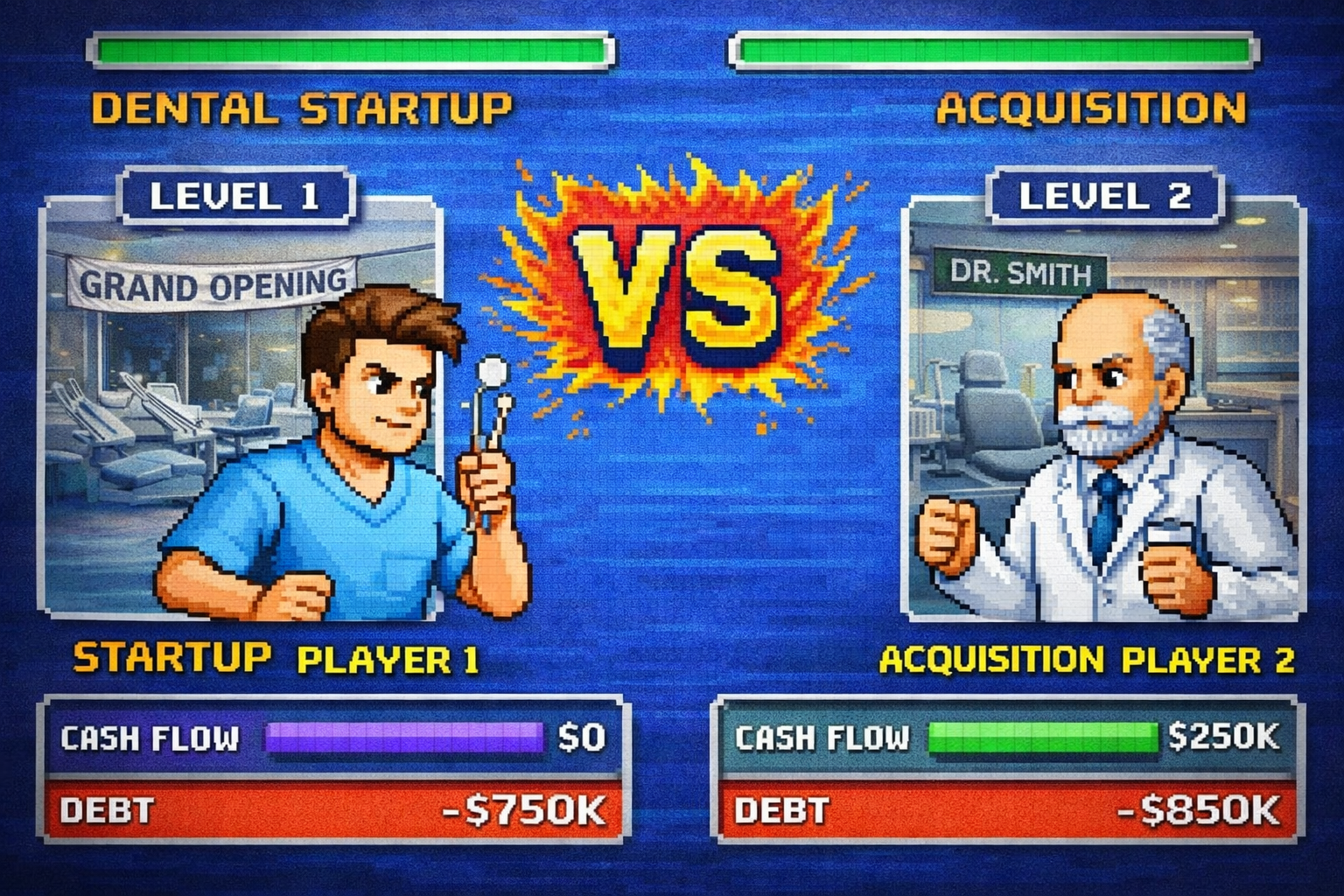
The Startup Cost: To open a decent 4-6 operatory practice today, you are likely looking at:
- $500k – $600k loan for build-out, construction, and equipment.
- $150k in working capital (because you have zero revenue on day one).
- Total Debt: ~$750,000.
The Acquisition Cost: For a solid practice collecting $1M a year:
- $800k purchase price.
- $50k – $100k working capital.
- Total Debt: ~$850,000 – $900,000.
At first glance, the startup loan is smaller. But remember: The startup loan is speculative. You are betting on your ability to market and sell from a dead stop. The acquisition loan is collateralized by proven cash flow. Banks know this, which is why it’s often easier to get a loan to buy a million-dollar practice than to start one from scratch.
Cash Flow: The First 5 Years
This is where the rubber meets the road—your personal bank account. The difference in cash flow between these two paths during the first few years is staggering.
In Year One of a startup, you are fighting for every single patient. Even if you do well and collect $350k, after overhead, loan payments, and an aggressive marketing budget, you are likely taking home zero dollars. You might even be feeding the practice with your own savings. You are the janitor, the receptionist, and the doctor.
Compare that to Year One of an acquisition. You walk in on Monday morning to a full schedule. Even with a higher loan payment, if you buy a practice collecting $1M with 60% overhead, you are likely taking home $250,000 or more immediately.
The Opportunity Cost: In the first three years, the dentist who bought the practice has likely pocketed half a million dollars more in personal income than the dentist who started from scratch. If all other factors are equal, the acquisition wins the math war because you are buying time, and time is money.
Why Would Anyone Do a Startup
If the acquisition puts money in your pocket immediately, why bother with the stress of a startup?
The problem with acquisitions is what happens down the road. When you buy, you are inheriting someone else’s history. This often includes:
- Legacy Equipment: Chairs and tech that break down and need replacing.
- Culture Clash: A team you didn’t pick, who may be loyal to the old doctor and resistant to your leadership.
- Fee Ceilings: Fighting against a patient base used to low fees (“that’s what we’ve always paid”).
A startup is painful at first, absolutely. But you build it right from the ground up. You have modern technology, a hand-picked team, and high fees from day one. By Year 5 or 7, a successful startup in a good area can blow past the revenue ceiling of an older acquisition. It is the classic case of short-term pain for long-term gain.
The X-Factor: Demographics and Location
Here is the truth that overrides all the math we just did. The winner isn’t determined by “Startup versus Acquisition.” It is determined by the market.
Imagine Scenario A (Acquisition): You find a practice with great cash flow, but it’s in a shrinking town with an aging population. That cash flow is a mirage. You are buying a sinking ship.
Imagine Scenario B (Startup): You find a “Boom Town.” Explosive population growth, high income, low competition. Even if you make zero dollars in year one, the demographic wave will carry you to massive success.
The Ultimate Rule:
- If demographics are roughly equal: The Acquisition wins. The safety net and immediate income are too valuable to ignore.
- If the startup location is significantly better: The Startup wins. Always bet on the better market over the easier start.
The long-term growth of the area is the single biggest predictor of your eventual net worth. A mediocre dentist in a booming market will often outperform a great dentist in a dying market.
I want to hear from you. Be honest in the comments: are you leaning towards a startup because you have a specific vision, or just because you’re afraid of the “big loan” of an acquisition? Let me know your real motivation.