

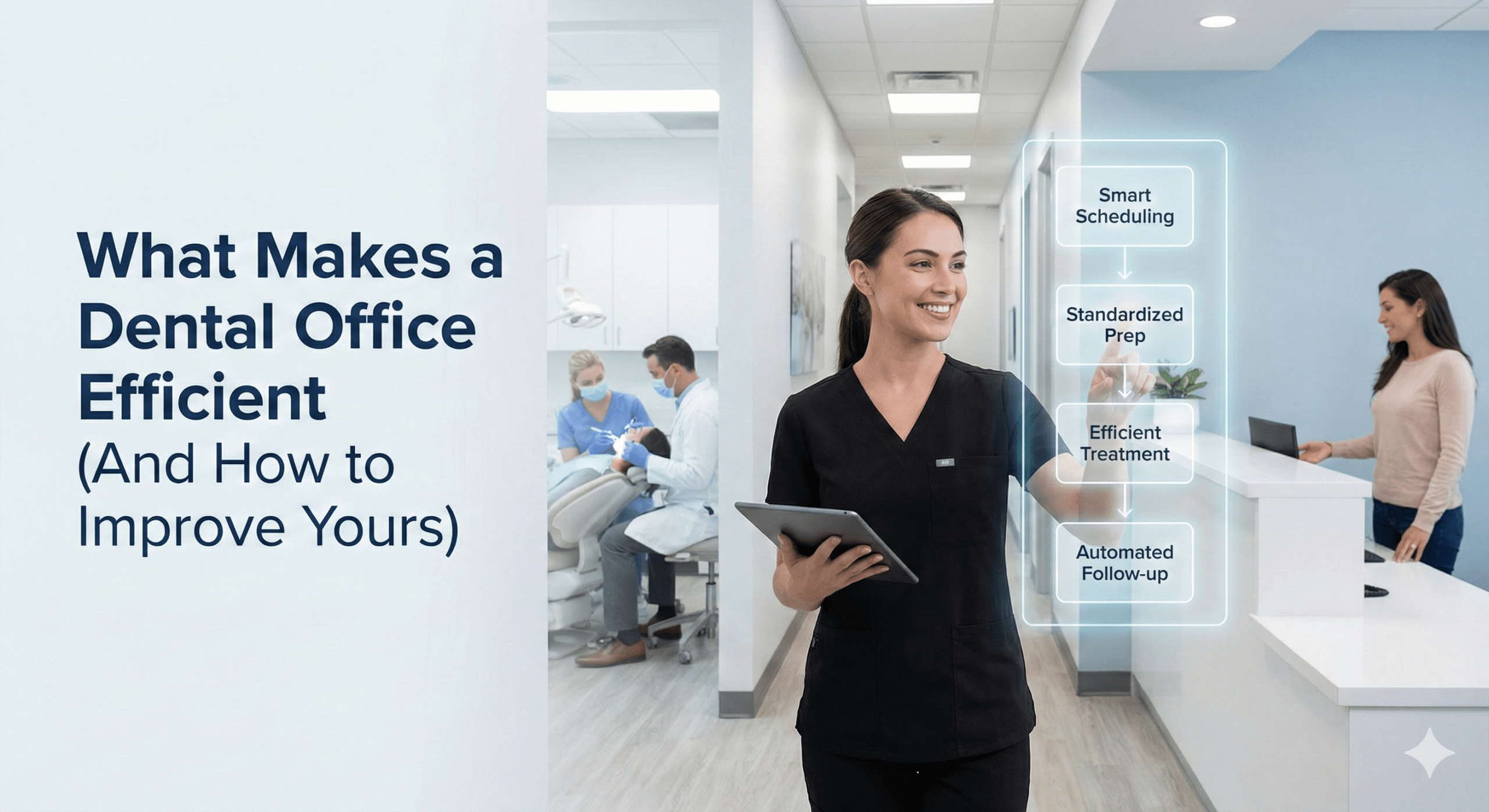
Most dentists hear the word “efficiency” and immediately think of a stopwatch. They think it means running through the hallways, double-booking columns until the team breaks, and “working faster.”
But real efficiency is actually the opposite of rushing. It is the art of reducing friction. When your office is truly efficient, every minute, every action, and every team member contributes to a smoother, more profitable day. If your team constantly feels behind, your schedule runs late, or your production doesn’t match your level of effort, you don’t have a speed problem—you have a friction problem.
This guide is part of our Managing a Dental Practice series, designed to help you build a calm, predictable, high-performing business.
1. The True Definition of Dental Office Efficiency
Efficiency isn’t about working harder; it’s about working cleaner. An efficient office delivers maximum clinical results with minimum wasted time, motion, and stress.
In a high-flow practice:
- Patients move from the waiting room to the chair without bottlenecks.
- Team members know exactly what to do next without being told.
- The doctor never has to wait for a room to be turned over or a patient to be numbed.
If you aren’t there yet, it’s usually because of the “Hidden Killers” of efficiency.
2. The 3 Hidden Killers of Efficiency
Most inefficiency in dentistry is invisible until it shows up as a stressful day or a flat profit margin. Look for these three offenders:
- Unclear Systems: If the team has to “figure it out” every morning, you are leaking time.
- Poor Schedule Design: A “full” schedule isn’t always a productive one.
- Communication Gaps: Missed handoffs and redundant conversations are the primary source of office drama.
Related Reading: 10 Dental Office Inefficiencies That Are Costing You Thousands
3. Step 1: Streamline Your Scheduling System
Your schedule is your practice’s production engine. If the engine is tuned poorly, it doesn’t matter how fast you drive.
- Block Scheduling: Use time blocks based on procedure length and production goals.
- Cluster Booking: Group similar procedures to reduce setup changes and mental fatigue.
- Protect the Doctor: Train the front office to ruthlessly protect your “primary” production time.
Learn how to master this in our guide on How to Run a Successful Dental Practice Step-by-Step.
4. Step 2: Standardize Your Clinical Workflows
Every minute counts in the operatory. When setups vary from one assistant to another, or supplies aren’t where they should be, you lose hours of production every week.
- The “Kit” Concept: Use pre-assembled tubs or cassettes for every procedure.
- Visual SOPs: Have laminated photos of exactly how a room should look for a Crown vs. a Filling.
- Identical Setup: Ensure every operatory is stocked identically so you can walk into any room and find what you need.
Tip: Start building your checklists with The Step-by-Step Guide to Building Dental Office Systems.
5. Step 3: Simplify Communication and Delegation
Most “team problems” are actually just symptoms of unclear communication.
- The Morning Huddle: Use 10 minutes to anticipate roadblocks, not to dwell on yesterday. (See our Morning Huddle Guide).
- Centralized Tools: Use tools like Weave or Slack to reduce hallway chatter.
- Ownership: Define who is responsible for what. There is no such thing as an “everyone” task—if everyone is responsible, no one is.
6. Step 4: Track the Efficiency Metrics
What you measure, you improve. Track these indicators monthly to see where the friction is hiding:
| Metric | Ideal Range | What It Tells You |
| On-Time Starts | 90%+ | Team coordination and punctuality |
| Chair Turnover | <10 min | Operatory and sterilization flow |
| Case Acceptance | 70%+ | Treatment coordination efficiency |
| Hygiene Reappointment | 85%+ | Recall system health |
You can find the full list in The Top 10 KPIs Every Dental Practice Manager Should Track.
7. Step 5: Build a Culture of Continuous Improvement
Efficiency isn’t a one-time project; it’s a mindset. At your monthly team meetings, ask: “What slowed us down this month?” Encourage your team to find the “small wins.” When you eliminate a 2-minute friction point that happens 10 times a day, you just handed your team 20 minutes of peace back.
🚀 Take Action: Download Your 90-Day Practice Growth Plan
Efficiency is the multiplier for everything good in your practice. When you reduce friction, production goes up while stress goes down. But you can’t fix everything at once.
Download the Free 90-Day Practice Growth Plan Here — This roadmap will help you identify your biggest friction points and give you a week-by-week plan to eliminate them.
Looking for the complete framework for clinical and front-office efficiency? Explore our Dental Business Fundamentals Course.