

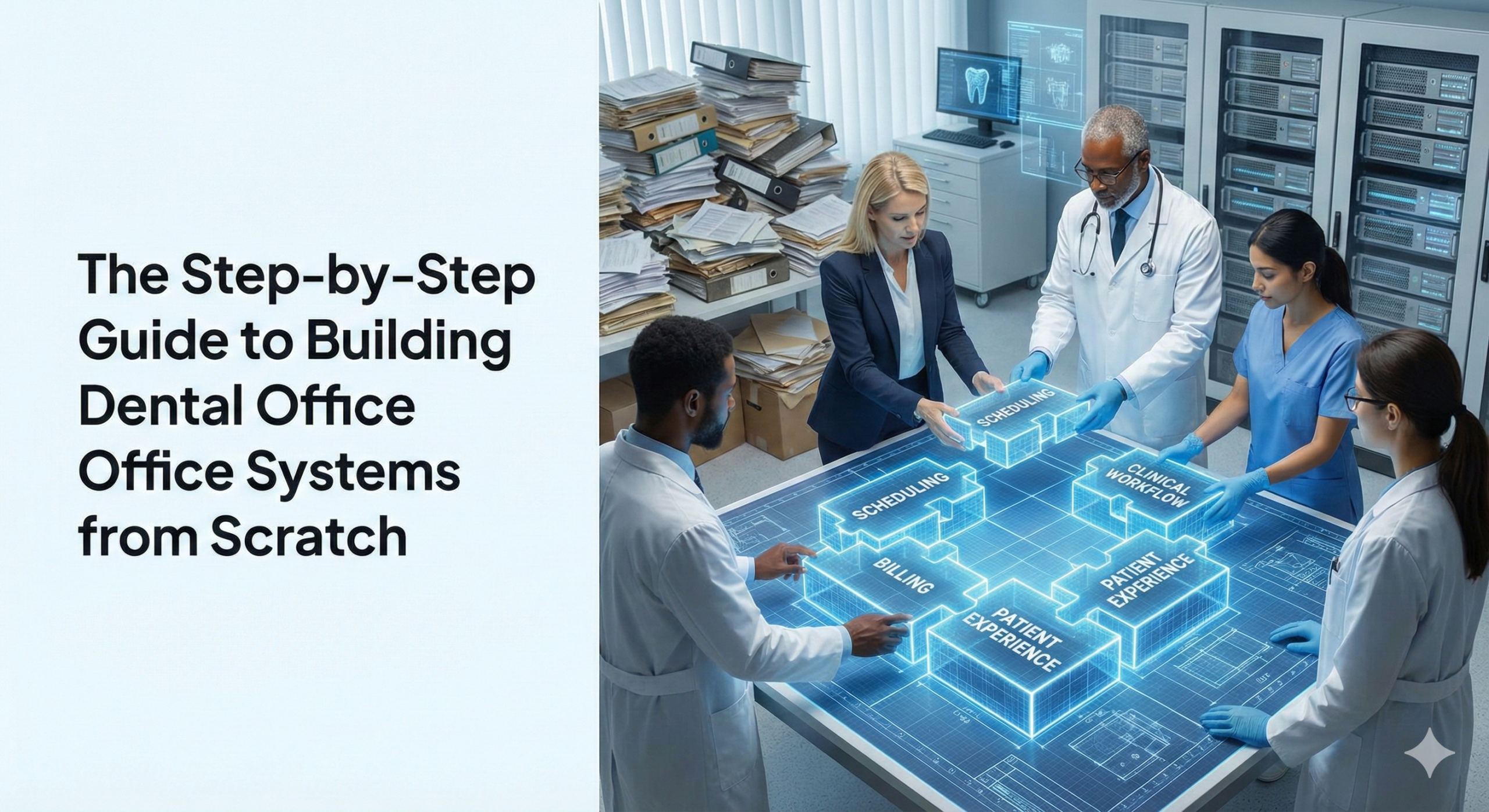
Every thriving dental practice runs on well-designed systems. Without them, you are managing by memory and personality—which works only until your next hire quits or a key person gets sick.
If you’ve ever found yourself asking, “Why can’t my team just do it the same way every time?”—the problem isn’t your people; it’s your systems. In this guide, you’ll learn exactly how to build dental office systems from scratch and, more importantly, how to make them stick.
This article is part of our Managing a Dental Practice series—the complete roadmap for building a scalable, system-driven business.
1. What Actually Makes a “System”?
A true system isn’t just a checklist taped to a wall. It is a repeatable, measurable process that produces a consistent result regardless of who is performing the task.
A great system must be:
- Documented: Written or digital instructions accessible to everyone.
- Measurable: Tied to a specific KPI or result.
- Trainable: Simple enough for a new hire to follow on day one.
- Audited: Reviewed regularly to prevent “system drift.”
Learn More: Understand the core of efficiency in What Makes a Dental Office Efficient?.
2. Step 1: Prioritize Your “Pain Points”
You don’t need to systemize the entire office in a weekend. Start where it hurts the most. Ask your team: “Where are we wasting the most time or making the most mistakes?”
Common starting points include:
- New Patient Intake: How we handle the first phone call.
- Scheduling and Cancellations: Protecting the production blocks.
- Insurance Verification: Ensuring we get paid 100% of what we’re owed.
Tip: Use our guide on How to Audit Your Practice to find your biggest hidden leaks.
3. Step 2: Map the Workflow
Before you write a single word, you must visualize the process. Grab a whiteboard and map the “Patient Path.”
- The Workflow: Patient calls → Insurance verified → Appointment scheduled → Forms sent → Patient arrives → Clinical handoff.
Mapping helps you spot redundant steps or bottlenecks where information gets dropped. Combine this with the Ultimate Dental Office Workflow Template.
4. Step 3: Document the SOP (Standard Operating Procedure)
In 2026, documentation should be agile. Move away from dusty binders and toward a digital “Practice Playbook” (using tools like Notion, Google Drive, or specialized dental software).
Each SOP should include:
- The Purpose: Why does this task matter?
- The “Who”: Which role owns this task? (See: Dental Office Roles & Responsibilities).
- The Steps: A clear, numbered list.
- The Video (Pro-Tip): Record a 2-minute “Loom” video of the task being done correctly. It’s 10x more effective than text for training.
5. Step 4: Assign System Ownership
A system without an owner is just a suggestion. For every system you create, assign a System Owner. This isn’t necessarily the person who does the task, but the person responsible for ensuring it stays updated and that the team is following it.
Leadership Note: Learn how to delegate these responsibilities in How to Train Your Office Manager to Lead Like a CEO.
6. Step 5: The “3-Step” Training Method
Don’t just hand a team member an SOP and hope for the best. Use this rollout strategy:
- I Do: They watch you (or the System Owner) perform the task.
- We Do: You perform the task together.
- You Do: They perform the task while you observe and provide feedback.
7. Step 6: Audit and Refine
Systems are like teeth—they require regular maintenance to prevent decay. Build a rhythm of auditing one system per week during your Morning Huddles. Ask, “Is this still the best way to do this? What’s the friction point?”
Conclusion: Systems Create Freedom
A great dental office isn’t built on the backs of superheroes; it’s built on the strength of its systems. When your office runs on a “manual” rather than your personal energy, you gain the freedom to lead, the ability to scale, and a practice that truly serves you.
🚀 Take Action: Download Your 90-Day Practice Growth Plan
Building systems from scratch can feel overwhelming if you don’t have a timeline. We’ve mapped out the exact sequence to help you systemize your highest-impact areas first without burning out your team.
Download the Free 90-Day Practice Growth Plan Here — A week-by-week roadmap to help you map your workflows, write your first 5 SOPs, and establish an accountability rhythm.