
My first patient this morning walked in and, before any pleasantries, informed me she was allergic to all colorings and all flavors. Not a mild rash. She calmly stated that if I used anything with them, her tongue would swell and she would, quote, “die within two minutes.”
But wait, there’s more. Due to vertigo, I couldn’t recline her chair more than a few inches, meaning I was about to work on the maxillary second molars of a patient sitting completely upright.
In that moment, a few thoughts flickered through my mind: “Why am I doing this? Is this job really worth it today?”
If you’ve been practicing for any length of time, you’ve had a patient—maybe not this exact combination, but someone so uniquely challenging—that you can relate to that feeling. It highlights a core truth of our profession: the technical skills of dentistry are not the hardest part. The hardest part is working with people, and all the complexity they bring with them.
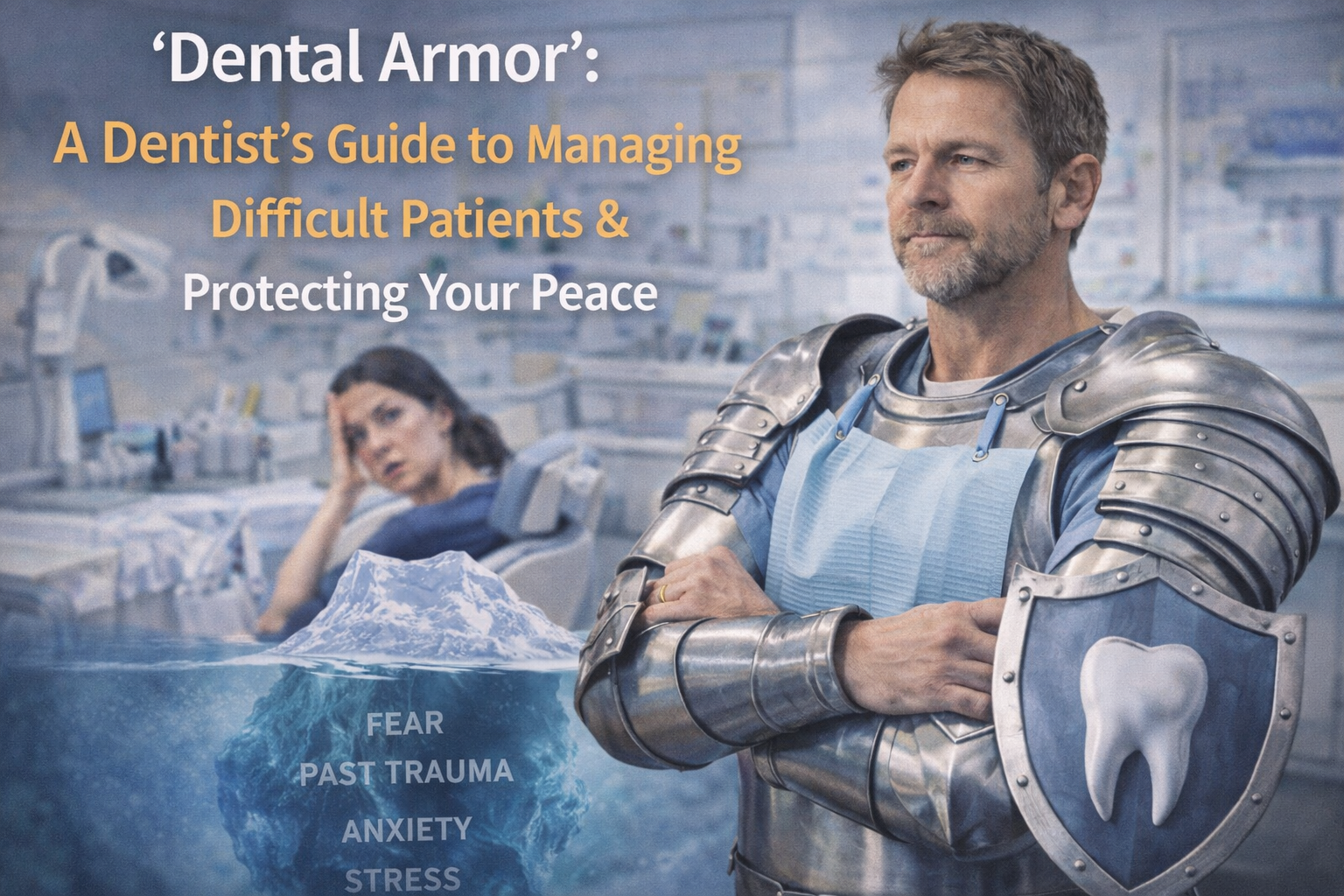
Any patient encounter that leaves you feeling stressed, frustrated, or exhausted can derail your entire day and steal your joy. Today is about building your “Dental Armor”—a set of mindset shifts and practical strategies to navigate these encounters with grace, protect your well-being, and stay in control.
Mindset Shift #1: Detach and Depersonalize (It’s Not About You)
Our first reaction to a difficult patient is often to take it personally. If they’re rude, we think, “What did I do wrong?” If they’re demanding, we feel our expertise is being challenged.
Here’s the critical shift: What if, the vast majority of the time, the patient’s challenging behavior has very little to do with you?
Think of a patient like an iceberg. The behavior we see is just the tip. Underneath the surface is a massive, unseen collection of their own fears, past traumas, life stressors, and anxieties. This is the concept of “patient projection.”
- Their irritability might be a manifestation of profound dental fear.
- Their frustration could be spillover from a horrible day at work or home.
- Their skepticism could be a reaction to a past negative dental experience (dental PTSD).
Their behavior is often a defense mechanism, a shield they’re putting up against their own internal state. Your first act is to adopt the mantra: “This patient’s behavior is a reflection of their internal state, not an accurate measure of my worth.” Consciously create distance. This doesn’t mean being cold; it means you stop absorbing their negativity as a personal attack.
Watch the full, in-depth guide on building your “Dental Armor.”
Mindset Shift #2: Cultivate Professional Empathy
This is different from sympathy, and it is not about condoning abusive behavior. Professional empathy means striving to understand the feeling behind the behavior, even if you don’t agree with the behavior itself.
Instead of thinking, “Why are they being so unreasonable?” shift your internal question to, “I wonder what’s going on for this person that’s causing them to act this way?”
This small shift allows for a more compassionate approach. You can validate their feeling (“I can see this is frustrating for you“) which can be surprisingly de-escalating, without abandoning your professional boundaries. You can be both understanding and firm.
Mindset Shift #3: Reframe as a “Clinical Challenge” or “Communication Puzzle”
The moment you internally label someone a “problem patient,” you’ve already lost. That label colors the entire interaction as adversarial.
Instead, reframe it.
- A medically complex case like my patient this morning is a “complex clinical challenge.”
- A patient with difficult behavioral issues is a “communication puzzle to be solved.”
This simple change engages your professional, problem-solving brain instead of your emotional, reactive one. The “win” isn’t always making them happy; sometimes the win is safely navigating a difficult procedure or skillfully de-escalating a tense situation.
Actionable Strategies for Difficult Encounters
With these mindsets in place, here are your tools:
- Active Listening: Often, a difficult patient just wants to feel heard. Listen without immediately correcting or defending.
- Maintain a Calm Tone: Your calm demeanor is a powerful de-escalation tool. Do not mirror their negative energy.
- Set Clear Boundaries: It is okay to be firm and professional. You can say, “I am here to help you, but for us to work together effectively, I require our discussion to remain respectful.”
- Know When to Dismiss: Sometimes, a relationship is not a good fit. Knowing how to professionally dismiss a patient is a crucial skill for your own self-preservation.
- Use a “Mental Rinse” Routine: After a tough encounter, consciously let it go. Do not carry it to your next patient or home to your family. A brief, constructive debrief with your team focused on “lessons learned” can be helpful.
You will never have a practice completely free of challenging patients. That’s unrealistic. The goal is to develop the internal fortitude and external skills to handle them effectively, without letting them diminish your passion for the profession.