

Key Takeaways
- The Effort Illusion: Sweat does not equal success. High-production days should feel calm and controlled, while chaotic days are often the least profitable.
- The “Magic Number”: To net $1M annually, you need a daily production target of approximately **$7,000** (based on 18 clinical days/month).
- The $875/Hour Filter: Every procedure must be viewed through the lens of your hourly goal. This shift forces a move from “patchwork” to comprehensive quadrant dentistry.
- Sacred Block Scheduling: Protect your high-value production blocks with a “firewall” to prevent “sand” (low-value junk) from filling your best time.
- Morning Mapping: Spend 15 minutes alone before the huddle to “find the money” in the existing schedule rather than hoping for new calls.
There is a dangerous lie in dentistry: If I want to make more money, I have to work harder. We are trained to equate exhaustion with productivity. If you aren’t running breathless between operatories while eating a three-minute lunch over a trash can, you feel lazy.
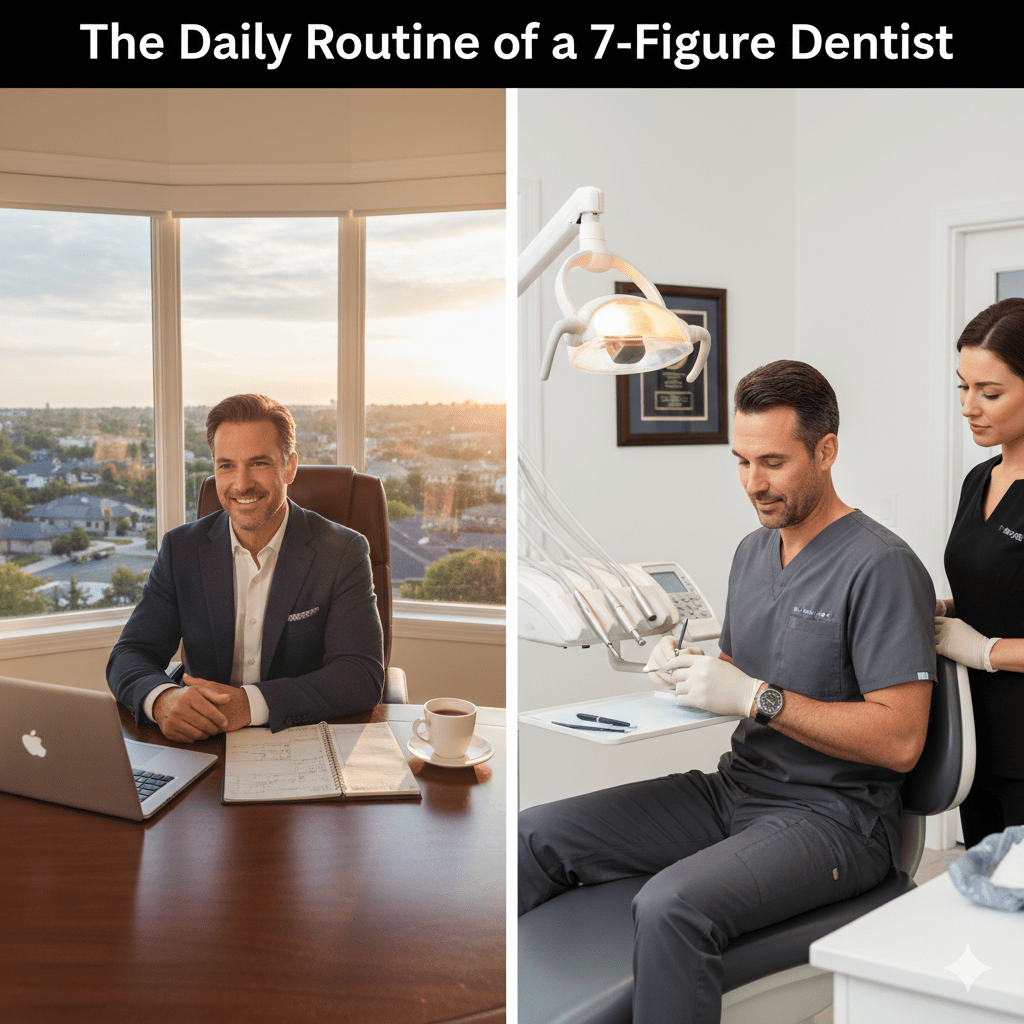
But here is the honest truth: The days I worked the hardest—the days I went home with a throbbing back—were usually the days I made the least amount of money. The days I produced $8,000, $9,000, or $10,000? Those days felt calm. Sometimes, they even felt boring.
The difference between the dentist burning out at $600k and the one effortlessly taking home $1M isn’t clinical speed; it’s scheduling architecture.
The Reverse Engineering: Your Magic Number
To take home $1M, your practice needs to collect roughly $2M. If hygiene produces 25%, you (the doctor) must personally produce $1.5M.
If you work 18 days a month, the math is simple: Your daily production goal is $7,000.
Broken down further into an 8-hour day, that is $875 per hour. This number is now your filter for reality. When you look at a single MO composite, you have to ask: Does this generate $875 an hour? Usually, the answer is no. This forces you into a Quadrant Dentistry mindset, treating disease comprehensively instead of patching holes.
Guarding the Schedule: Rocks vs. Sand
Most practices fail because they let the front desk fill the schedule with whoever calls. I call this filling your day with “Sand”—denture adjustments, single occlusal fillings, and suture removals.
To hit your $7k goal, you must use Block Scheduling for your “Rocks” (Crowns, Implants, Clear Aligner starts).
- The Firewall: Identify two-hour blocks in the morning and afternoon.
- The Rule: These blocks are sacred. They cannot be filled with anything other than high-value production until 48 hours prior.
If you don’t defend these blocks, a $300 chipped tooth will inevitably occupy a $3,000 production slot. You can read more about this in 3 Systems That Will Make Your Practice Run Without You.
The 3-Day View & Morning Mapping
A 7-figure dentist doesn’t obsess over next month; they optimize the next 72 hours. If Thursday looks light, you don’t “hope the phone rings.” You move the puzzle pieces now by calling pending treatment or leveraging today’s emergencies to fill Thursday’s gap.
The most critical habit, however, is Morning Mapping.
- 15 Minutes of Silence: Arrive before the huddle. Sit alone with the schedule.
- Find the Gap: If you are scheduled for $5,500 but your goal is $7,000, you must find that $1,500 before the first patient walks in.
- Mine Hygiene: Scan every hygiene patient. Who has unscheduled treatment? Who has a “watch” that is now symptomatic?
Don’t walk into the huddle with observations; walk in with a plan. Tell your hygienist: “Mrs. Jones is in at 10:00. That MOD on #14 looks worse. Take an intraoral photo, put it on the big screen, and prime her for me to get it done at 11:00.” For more scripts on how to lead your team through this, see Dental Leadership 101: How to Lead Strong Personalities.
Why “Boring” is Profitable
A $3,500 day feels like chaos. You are running out of six operatories, doing ten hygiene checks, and adjusting partials. A $7,000 day often feels boring. You might do one massive implant case from 8:00 to 10:30, listening to music, focused, and unhurried.
You aren’t rushing because you aren’t trying to cram thirty patients into a day. You are simply executing a pre-designed plan. According to data from the American Dental Association (ADA), high-performing practices consistently report lower stress levels due to better-managed appointment workflows.
Take the Next Step
This daily routine is just one gear in the engine. To help you build the entire operating system, I’ve launched my Business Fundamentals Course. It covers the financial systems, leadership protocols, and scripts you need to stop playing small and start running a business that serves you.