
We’ve all been there. The patient is in the chair, writhing in pain from a hot tooth. You give your best block, wait ten minutes, and go to touch the tooth… they jump. The anesthesia isn’t working, your schedule is imploding, and your stress is skyrocketing.
A hot tooth can be one of the most stressful situations in clinical dentistry, but it doesn’t have to be.
This is not about hope; it’s about having a predictable, step-by-step protocol that consistently works. This is a battle-tested system to help you confidently and predictably numb up even the most stubborn tooth with total control.
First, Understand the Enemy
Why are inflamed teeth so resistant to our anesthetic? There are three main scientific reasons:
- Hyper-Excitable Nerves: Inflammation lowers the resting potential of nerve fibers, making them less responsive to anesthetic.
- Acidic Environment: Inflamed tissue has a lower pH, which interferes with the anesthetic molecule and prevents it from working effectively.
- Anatomical Factors: Increased blood flow can wash the anesthetic away, and accessory innervation can be missed by a traditional block, even with a numb lip.
Simple Tricks to Make Your Standard Injections More Powerful
Before moving to advanced techniques, you can make your primary injections far more effective.
- Buffer Your Anesthetic: Adding a small, specific amount of sodium bicarbonate to your lidocaine carpule right before injecting raises the pH of the solution. This leads to a faster onset and a more profound effect in that acidic environment.
- Use Articaine (Septocaine): If your initial lidocaine block is insufficient, re-injecting with articaine can often do the trick. Its higher concentration and superior bone penetration make it a powerful tool.
- Inject Slowly: A slow injection, delivered over a full 60-90 seconds, allows for better diffusion into the tissues and is significantly more comfortable for the patient.
Watch the full, in-depth guide to mastering hot tooth anesthesia.
Your Backup Plan: Advanced Injections for Stubborn Cases
What if you’ve tried all that and the tooth is still hot? This is where you need a reliable backup plan.
- The Buccal Infiltration with Articaine: This is your first and best follow-up for a mandibular molar block. Because articaine diffuses through bone so well, a simple buccal infiltration next to the hot molar is often the final piece of the puzzle.
- The PDL Injection: An intraligamental injection using a high-pressure syringe places anesthetic directly into the PDL space. It provides profound, single-tooth anesthesia, but be aware that the effect can be short-lived, so you need to work efficiently.
- The Intraosseous Injection: Using a system like an X-Tip, you can deliver anesthetic directly into the cancellous bone next to the apex. This bypasses all soft tissue and is incredibly effective when other methods fail.
- The Intrapulpal Injection (Last Resort): For endodontic cases, once you have pulp exposure, you can inject a small amount of anesthetic directly into the pulp tissue. While the injection itself is briefly painful, it provides instant and profound anesthesia.
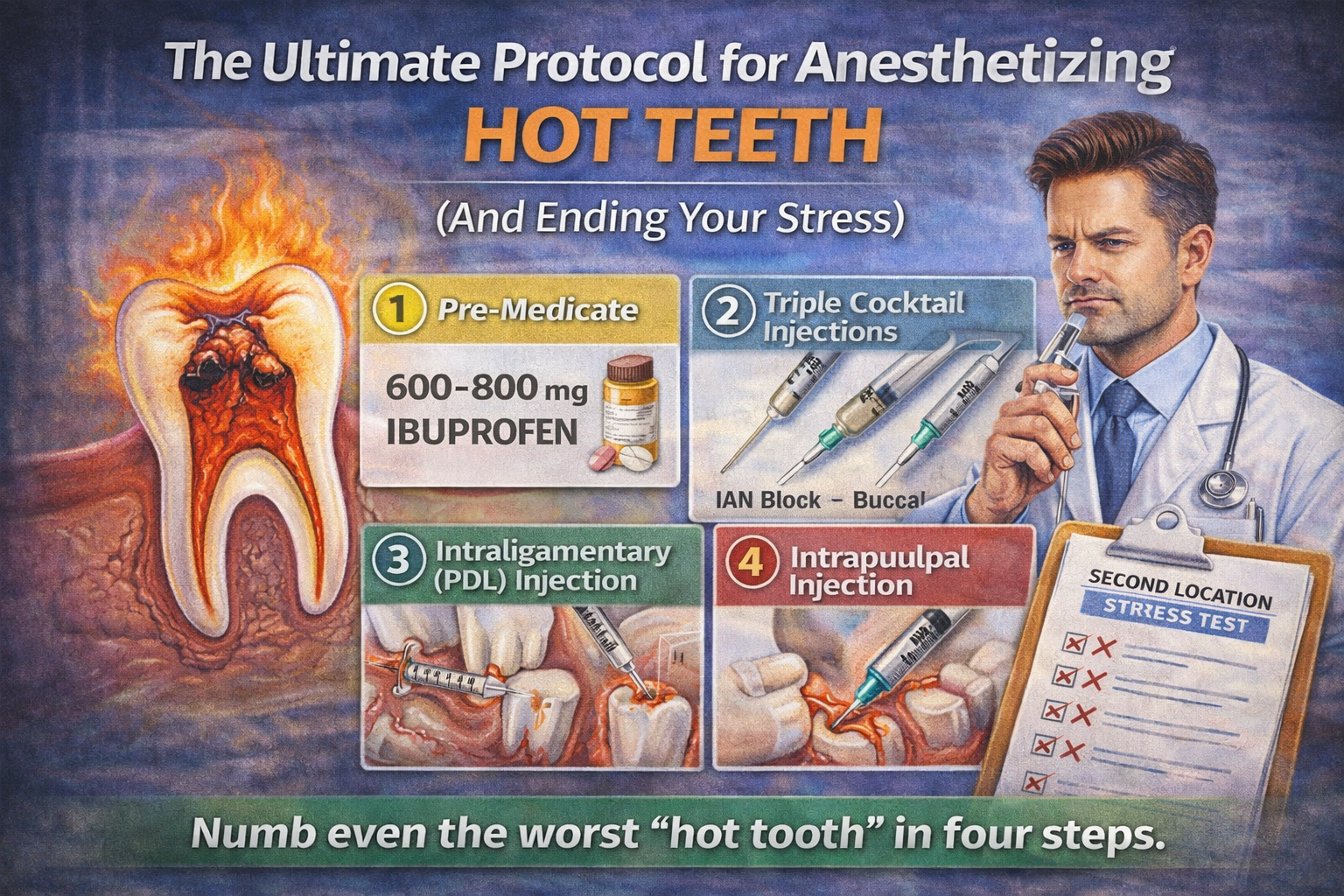
The Ultimate “Hot Tooth” Protocol in Practice
This is how you put it all together in a predictable sequence that will work 99% of the time.
- Pre-Medicate: Have the patient take 600-800mg of ibuprofen an hour before the appointment. This reduces pulpal inflammation and makes the anesthetic far more effective from the start.
- The “Triple Cocktail” Injection Sequence:
- Start with a good, slow IAN block (e.g., with lidocaine).
- Once the lip is numb, immediately follow up with a buccal infiltration of articaine next to the tooth.
- Test the tooth. If it’s still not profoundly numb, do not hesitate. Go straight to your intraosseous injection.
- Manage Patient Expectations: This is just as important as the injections. Before you start, set the stage:”Mrs. Jones, because your tooth is so inflamed, it can be a little stubborn to get numb. We’re going to be very patient, and it might take a few extra steps. But I promise you, we will not start until you are completely comfortable and don’t feel a thing.”
When you frame it this way, needing an extra injection isn’t a “failure”—it’s you executing your expert protocol, just as you said you would. It builds immense trust and keeps you in control. Stay calm, follow your system, and you can manage any hot tooth with confidence.