
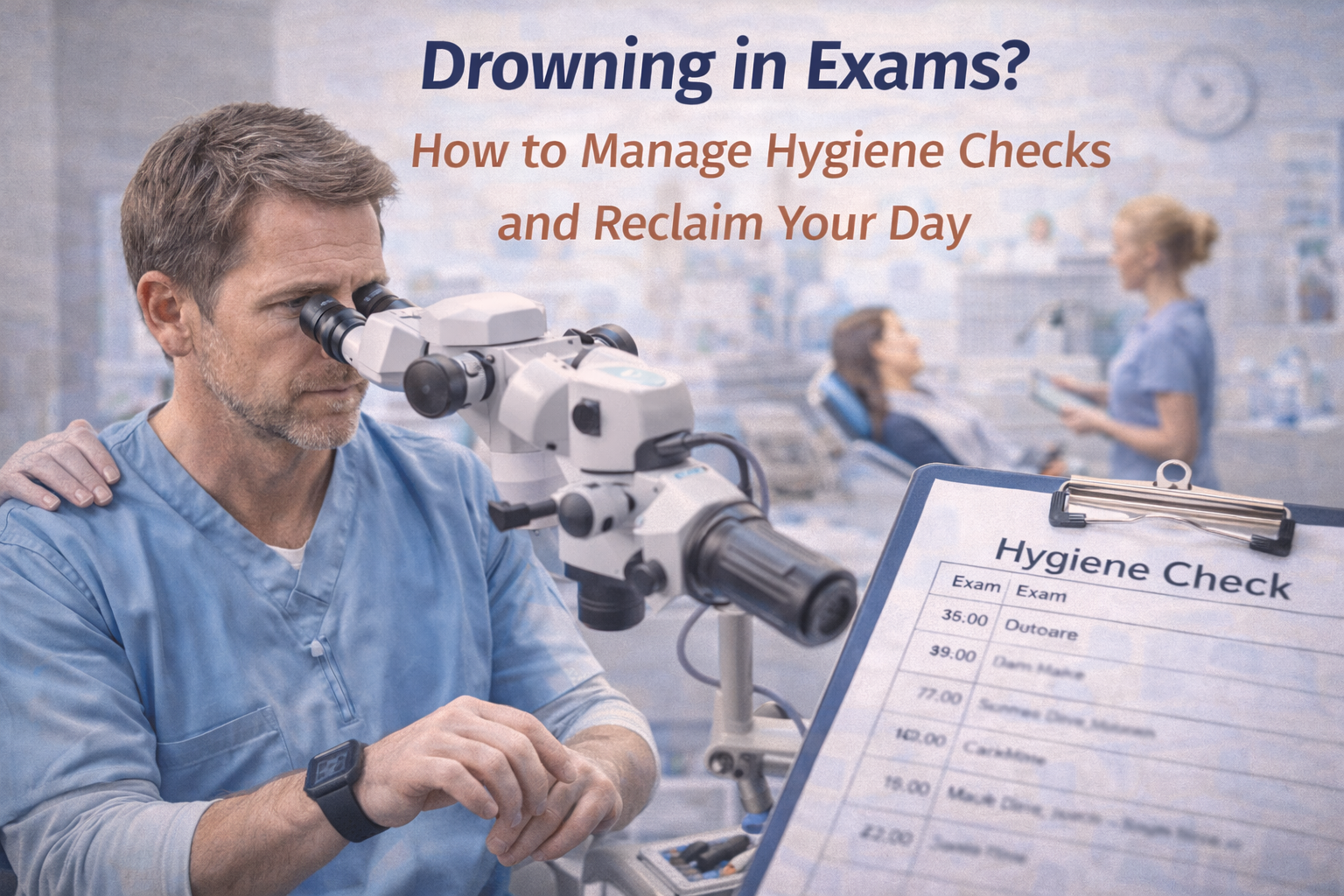
You’re in the middle of a complex procedure, completely in the zone, and then you feel it: the tap on your shoulder. “Doctor, your hygiene exam is ready.”
Your focus shatters. That “quick check” derails your primary procedure, puts you behind schedule, and injects a dose of stress into your day.
Many dentists feel like they’re constantly being pulled in multiple directions by the demands of hygiene checks. Some thrive with four chairs of hygiene; others feel overwhelmed by one. So, what’s the right number? And more importantly, how can you manage the flow so it doesn’t sabotage your productivity and your sanity?
This is your guide to taking control of your day, not letting the exams control you.
How Many Exams Are “Too Many”?
The truth is, there’s no magic number. The “right” amount of exams is the amount that allows you to consistently hit your practice’s production goals.
As a general ballpark, a dentist needs to diagnose roughly 300,000 to produce 100,000 to then take home 30,000. If you’re not producing as much as you want, it’s highly likely a result of one simple fact: you are not diagnosing enough dentistry.
The less complex or high-value the procedures you currently offer, the more exams you will need to find enough treatment to hit your goals. Therefore, the primary focus should always be on expanding your clinical skillset (implants, clear aligners, cosmetics) to diagnose more comprehensive care from the exams you already have.
Watch the full, in-depth guide on mastering your exam workflow.
3 Strategic Models to Manage Exam Volume
If you are genuinely overwhelmed and consistently hitting your production goals, here are three models to consider.
Strategy 1: The Yearly Exam Model
For a highly productive doctor in a stable practice, transitioning low-risk patients to yearly recall exams (while they still come for a 6-month prophy) is a viable option to reduce exam volume. Warning: Do not do this if you are not already exceeding your production goals. More than half of your diagnosed treatment often originates from hygiene.
Strategy 2: The “Two-and-One” Hygiene Model
This is arguably the best way to meet the demand of three hygienists without the exam load. Structure your department with two chairs doing traditional prophy/exam appointments, and dedicate the third chair to non-exam procedures like SRPs, perio maintenance, or whitening. This maintains hygiene production while protecting your time.
Strategy 3: The “Production Block”
Schedule a dedicated 2-3 hour “production block” each day for your most complex procedures. During this specific window, your hygiene chairs are designated as “no exam.” You get a protected period of deep clinical focus without shutting down your hygiene department.
4 Tactical Ways to Handle the Exams You Have
Regardless of the model, you need efficient systems.
1. Take Control of Your Exam Flow
Don’t wait for your hygienists to hunt you down. Proactively go to them when you have a natural break. Work with your team to develop a flexible mindset so they are ready for you at any point in their appointment. Aim to “batch” your exams, doing a “round” of checks once per hour.
2. Set Expectations for Work-Ins
Unscheduled exams can be disruptive. The key is to manage patient expectations. If you are fitting in an emergency, use a script: “Our schedule is very full, but we absolutely want to help you. We can work you into our overflow chair, but please be aware there may be a 30-minute wait. We promise we will see you as soon as possible.” Most patients are happy to wait when their expectations are set appropriately.
3. Plan Your Day Before it Starts
Arrive a little early and visualize your day. Look at your schedule and mentally map out when you anticipate doing your hygiene rounds. This simple act of pre-planning can dramatically reduce in-the-moment stress and improve your flow.
4. The “Slow Down to Speed Up” Method
This is the most critical tip. Spend time reviewing x-rays and charts in your private office before you enter the hygiene op. Scrambling to diagnose with the patient watching makes you feel rushed, prone to error, and projects a lack of confidence.
By preparing beforehand, you walk into the room with 90% of the clinical picture already figured out. You can then focus your energy on connecting with the patient, listening to their concerns, and confidently presenting any necessary treatment. This “slowing down” of the prep phase dramatically “speeds up” and improves the quality of the in-room exam.
Managing hygiene exams is a skill. By implementing these strategies, you can transform them from a source of constant interruption into a smooth, predictable, and highly profitable part of your practice.