
Key Takeaways
- Redefining the Exam: A “good” exam isn’t just clinically accurate; it is only effective if the patient understands and accepts the treatment.
- The 2-Minute Rule: Build human rapport before touching a single instrument to lower patient anxiety.
- Language Matters: Shift from “Features” (technical jargon) to “Benefits” (lifestyle impact) to drive emotional connection.
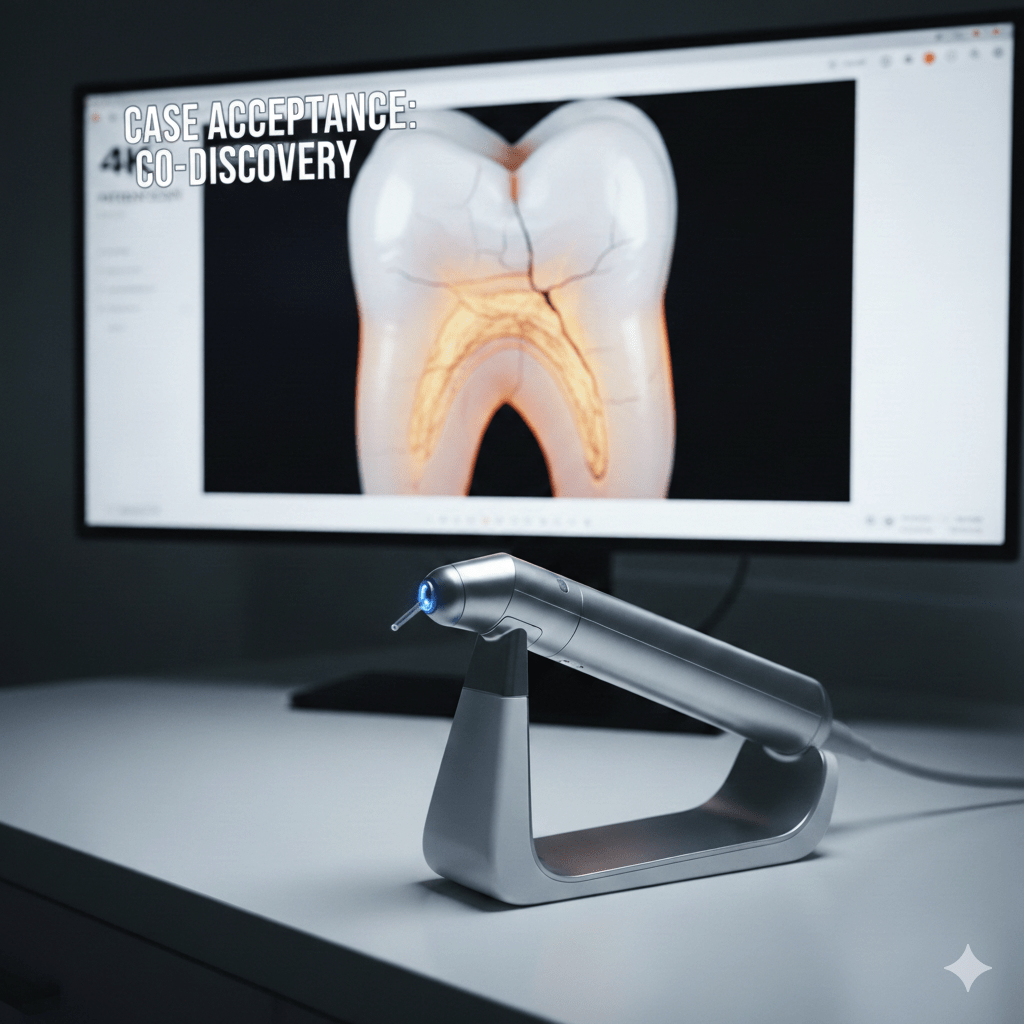
- Co-Discovery: Use intraoral cameras to let patients diagnose themselves, moving from “selling” to “collaborating.”
- Video Follow-Ups: Bridge the gap between the office and the home by sending personalized videos to decision-makers.
How good are your exams?
If I asked you that question right now, face to face, what would you say? Most clinicians immediately think about their technical precision—their ability to spot an incipient lesion or diagnose a hairline crack. But if your case acceptance is hovering at 30% or 40%, I have a hard truth for you: Your exams are ineffective.
The Crisis of Low Case Acceptance in Modern Dentistry
In my experience as a consultant and practitioner, the exam is the single most critical moment in the patient relationship. It is the bridge between a clinical problem and a life-changing solution. If that bridge is broken, the best clinical dentistry in the world never happens.
Nothing sucks the fun out of our profession faster than presenting a perfect, comprehensive treatment plan only to hear, “I’ll just wait until it hurts.” It’s demoralizing, it leads to dentist burnout, and eventually, it makes you cynical. You stop diagnosing the best care because you assume they won’t pay for it.
To fix this, we must look at two tiers of strategy: The Foundation (the non-negotiables) and The Breakthroughs (the top 1% psychology).
Tier 1: The 5 Non-Negotiable Foundations
These are the baseline pillars. If you aren’t doing these, you aren’t even in the game.
1. Build Rapport First (The 2-Minute Rule)
We are engineers of the mouth, but people don’t buy from engineers; they buy from people they like. For the first two minutes of an appointment, you are not allowed to talk about teeth. Talk about their family, their hobbies, or their weekend. This lowers cortisol and breaks the “white coat barrier.” When you eventually transition to talking about infection, they are listening to a friend, not a salesman.
2. Benefit vs. Feature Language
Stop using dental jargon. Patients do not care about “scaling and root planing”—it sounds terrifying. Shift to lifestyle impact. Instead of “5mm pockets,” talk about “treating an active infection to save your teeth so you can keep eating the foods you love.” If you don’t master this, you’re likely making common career-killing mistakes that stall practice growth.
3. The Transfer of Trust (The Handoff)
The momentum of a “yes” often dies at the front desk. You must recap the appointment to your coordinator in front of the patient.
- The Script: “Sarah, Mrs. Jones has a crack in her tooth that’s causing pain. We want to get this crown done before her daughter’s wedding so she isn’t in an emergency. Can you help her with the financial options?” This reinforces the “why” and transfers your authority to your team.
4. Remove Financial Friction
Cost is the #1 objection. Don’t just hand them a $5,000 estimate. Present the monthly payment. People buy cars and iPhones based on monthly budgets. Whether it’s third-party financing or your own membership plan, make it digestible. This is especially vital if you are trying to move away from the dental insurance trap.
5. Same-Day Dentistry
Strike while the iron is hot. Convenience drives acceptance. If you have blocks in your schedule, offer to start the work immediately. It saves them a second trip, a second numbing, and a second day off work.
Tier 2: The “Breakthrough” Strategies of the Top 1%
If you are doing the basics but still feel like you’re “selling,” it’s because you still own the problem. To achieve elite case acceptance, the patient must own the disease.
Breakthrough #1: The Power of Co-Discovery
The era of the “Sage on the Stage” is over. Patients are skeptical of experts but they trust their own eyes. Stop showing X-rays—to a patient, they just look like gray blobs.
Use an intraoral camera to give a “Tour of the Mouth” on a large 50-inch monitor. Ask questions instead of making statements: “Mrs. Jones, what do you notice happening around the edges of this silver filling?” When they see the crack or the black leakage in HD, they diagnose themselves. Now, you aren’t selling a crown; you are answering their question on how to fix a visible problem.
Breakthrough #2: The Personalized Video Follow-Up
Big cases (Full arch, aesthetic sets, etc.) often stall when a patient says, “I need to talk to my spouse.” When Mike goes home and tells his wife it’s $10,000 for “some crowns,” the value is lost.
Take two minutes at the end of your day to record a quick video (using your phone or a tool like Loom).
- Show the photos again on screen.
- Re-explain the “Why” and the long-term risks of waiting.
- Email it to them. Now, you are in the kitchen with the decision-maker, controlling the narrative and explaining the value personally.
Implementation Steps for Your Practice
If you’re ready to see a 30%–50% jump in production, start with these steps:
- Audit the Handoff: Record a few of your transitions to the front desk. Are they clinical or personal?
- Visual Confirmation: Ensure every operatory has a working intraoral camera and a monitor the patient can actually see.
- Language Shift: Create a “Cheat Sheet” for your team that replaces clinical terms (e.g., “Periodontal Disease”) with emotive terms (“Active Bone Infection”).
Case acceptance isn’t about being pushy. It’s about caring enough to ensure the patient understands what is happening in their own body so they can make the right choice. When you provide that clarity, the “yes” becomes the natural conclusion.