

If I asked you right now to define efficiency in a dental office, what is the first image that pops into your head?
For most of us, we imagine a pair of hands moving at lightning speed. We picture a dentist who can cut a crown prep in four minutes flat. We equate efficiency with the speed of our clinical execution. We think that if we want to produce more, we simply have to move our hands faster.
I want to challenge that today.
In fact, the idea that you need to be the Usain Bolt of dentistry is exactly what is capping your income and burning you out. I have visited hundreds of practices, and the doctors producing double the revenue are rarely the ones running from room to room with sweat on their brow. They are the ones who work at a calm, deliberate pace.
The difference isn’t hand speed. The difference is that the struggling doctor has fallen into the #1 Efficiency Trap: Over-Functioning Syndrome.
The Anatomy of a Wasted Hour (“Gap Time”)
We need to talk about the invisible killer of dental practices: Gap Time.
When you look at your schedule and see a 60-minute block for a crown, you assume that is 60 minutes of “productive time.” But let’s audit it:
- Walk in, chat, numb (GAP).
- Wait for anesthesia (GAP).
- Prep the tooth (ACTIVE TIME).
- Pack cord yourself (GAP).
- Make the temporary yourself (GAP).
- Wait for the impression to set (GAP).
If you strictly analyze the time where only you—the licensed doctor—could legally do the work, it was probably only 15 or 20 minutes. The rest was filled with tasks that could have been delegated.
The mistake we make is thinking we need to shrink the prep time. We stress out trying to shave seconds off our bur movement. But the leverage is in the other 40 minutes. The leverage is in the Gap Time.
The Solution: The Relay Race Methodology
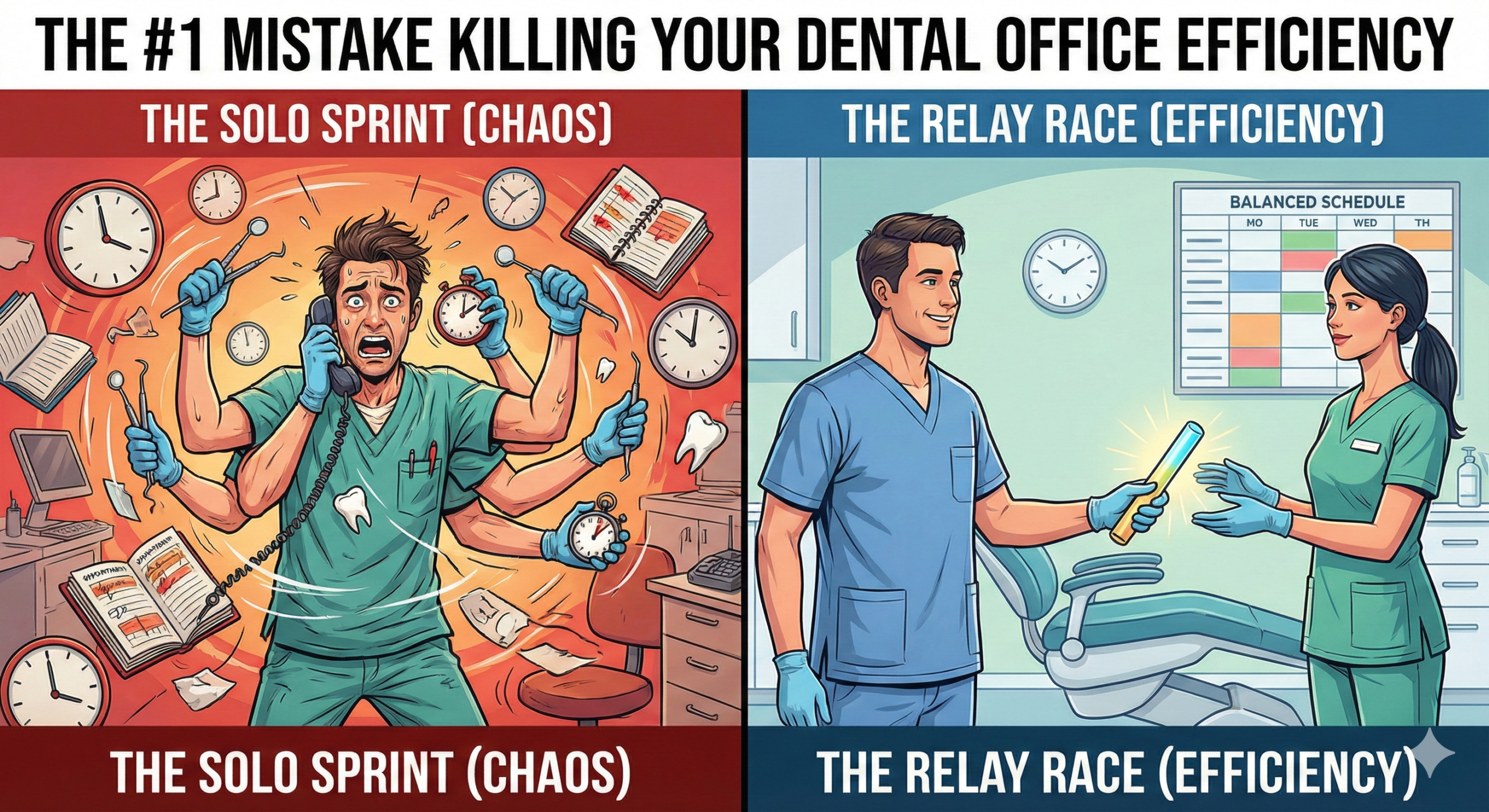
Most dentists run their practice like a series of Solo Sprints. You grab the patient at the front door, run the whole lap (x-rays, numbing, prep, temp), and collapse. Then you do it again. It is exhausting and unscalable.
A high-efficiency practice is a Relay Race. The goal isn’t for one person to run the whole mile; it’s to keep the baton (the patient) moving at maximum speed.
How it works:
- The Lead Runner (Assistant): Brings patient back, reviews history, takes vitals, places topical.
- The Anchor (Doctor): Steps onto the track only for the “Critical Path”—anesthesia and prep.
- The Handoff: Once the prep is done, you hand the baton back. The assistant makes the temp, takes the scan, and dismisses.
The “I Can Do It Faster” Trap
I can hear the resistance: “But Ryan, I can make a temp in 3 minutes. My assistant takes 15. It’s faster if I do it.”
This is the most dangerous lie in dentistry. We have to look at the math, not the stopwatch.
The Math of Delegation:
- Your Time: If your goal is $1,000/hr, your time is worth ~$17/minute. Spending 5 minutes on a temp costs the practice $85.
- Assistant Time: At $30/hr, their time is $0.50/minute. Even if they take 15 minutes, it costs the practice $7.50.
You spending $85 to save 10 minutes is bad business. When you stay in the room to do “low-value” tasks because of your ego, you are stepping over dollars to pick up pennies.
Operating at “Top of License”
In a hospital, you will never see a neurosurgeon changing bedpans. It is not because they are arrogant; it is because they are a scarce, expensive resource.
In your practice, you are the neurosurgeon. Yet, so many of us insist on playing the nurse and the janitor.
- Every time you clean up cement your assistant could have grabbed…
- Every time you walk a patient to the front desk…
- Every time you stop to answer a billing question…
You are becoming the bottleneck.
The “Telescoping Schedule”
When you train your team to operate at the top of their license, you unlock the Telescoping Schedule.
- Crown Appt (90 mins): Assistant owns the first 30 and last 30. You only own the middle 30.
- The Result: While Assistant A is finishing the temp in Op 1, Assistant B is numbing the patient in Op 2. You float between Critical Paths.
This is how you produce $5k or $6k a day without rushing. You aren’t working harder; physically, you are doing less.
Your Next Step
To fix this, you have to let go of control. You have to be willing to let your assistant struggle through a few temps while they learn. You have to endure the short-term inefficiency of training to get the long-term freedom of delegation.
Efficiency isn’t about being a manic, high-speed machine. It is about being a calm, focused leader who trusts their team to carry the baton.